

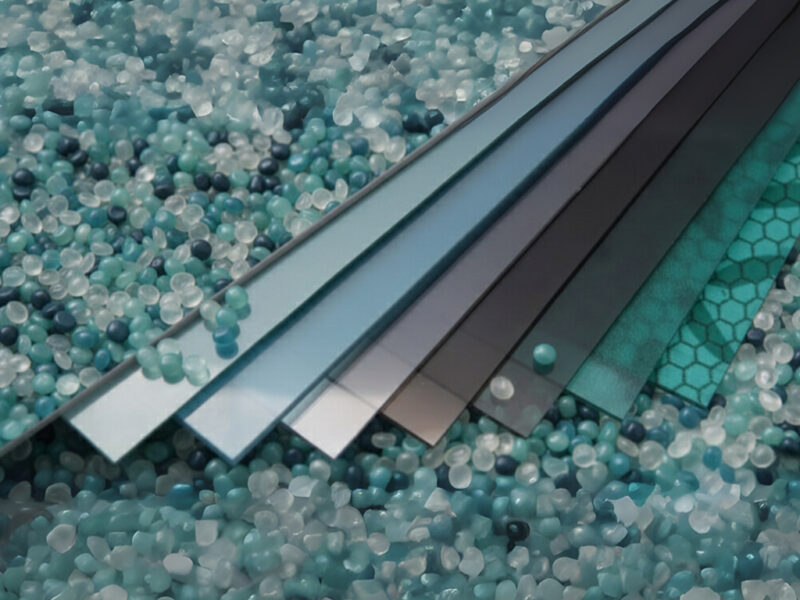
Polycarbonate (PC) is one of today’s most important engineering plastics. It offers light transmission close to glass, excellent impact resistance, and strong dimensional stability, making it highly popular. In the article below, Thai Duong Plastics provides comprehensive information about PC to help you evaluate, select materials, and design for efficient manufacturing.
Key Information About Polycarbonate (PC)
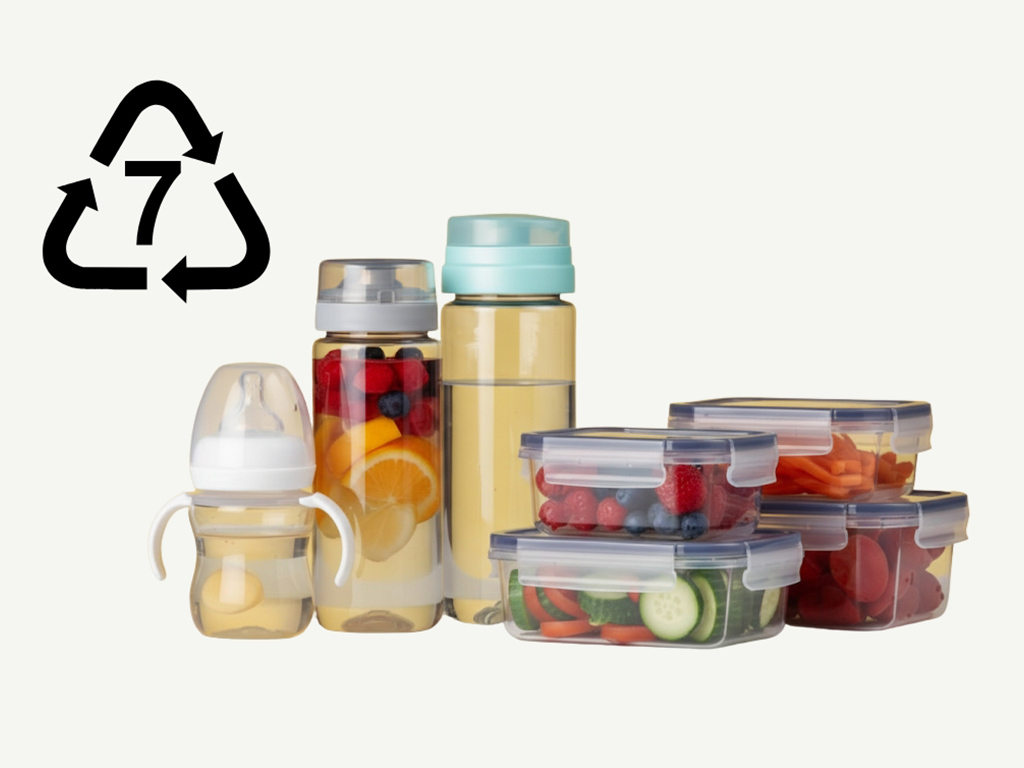
Polycarbonate (PC) is an amorphous engineering thermoplastic. Its polymer units are linked by carbonate groups, giving the material high transparency, toughness, and outstanding impact strength. PC falls under Resin Identification Code (RIC) #7. PC sheets can be clear or translucent, can be colored, and can receive functional coatings such as scratch-resistant hard coats and UV protection.
Compared with other common engineering plastics, polycarbonate stands out for impact strength and heat resistance. PMMA is clearer and more scratch-resistant but brittle. PETG is easier to 3D-print but weaker in mechanical and thermal performance. PC/ABS balances toughness, heat resistance, and processability for general-purpose production.
Manufacturing and Processing of Polycarbonate
In industrial production, polycarbonate is made primarily by two routes:
- Method 1: Polymerizing bisphenol A (BPA) with phosgene to form polycarbonate chains with well-controlled molecular weight.
- Method 2: Transesterification between BPA and diphenyl carbonate under catalysis-now preferred because it avoids phosgene.
Many producers add stabilizers for UV resistance, flame retardants, heat stabilizers, and glass fibers for reinforcement. Some modern processes incorporate CO2 into the upstream feedstock chain.

PC can be processed flexibly by injection molding (melt temperature 260 – 300 °C), extrusion, machining, and FDM 3D printing (requires high temperatures, a heated bed ≥ 90 °C, and an enclosed chamber).
PC Grades
Commercial polycarbonate is available in many grades tailored to diverse applications. Beyond clear, virgin PC, grades include glass-fiber-reinforced versions for higher stiffness, UV-stabilized grades for outdoor use, and flame-retardant grades for electrical devices. Certain specialty lines are produced BPA-free to meet food and drinking-water safety standards.
Technical Data and Properties of PC
The specifications and properties below guide application ranges as well as processing and storage of polycarbonate:
| Polycarbonate Technical Data (Typical) | ||
| No. | Property | Typical value |
| 1 | Density | 1.20 – 1.22 g/cm³ |
| 2 | Light transmission | 86 – 90 % |
| 3 | Tg | 147 – 150 °C |
| 4 | HDT @ 1.8 MPa | 128 – 140 °C |
| 5 | Tensile strength | 55 – 75 MPa |
| 6 | Young’s modulus | 2.2 – 2.5 GPa |
| 7 | Notched Izod | Approx. 600 – 850 J/m |
| 8 | Dielectric strength | 16 – 35 kV/mm |
| 9 | Injection-molding shrinkage | 0.5 – 0.9% |
Mechanical
PC excels in impact resistance-among the highest of engineering plastics. With tensile strength (55 – 75 MPa) and elastic modulus (2.2 – 2.5 GPa), it offers an effective balance of stiffness and toughness. Its low injection-molding shrinkage (0.5 – 0.9%) helps maintain dimensional stability, ideal for precision parts.
Optical and Thermal
Optically, PC is one of the few transparent plastics, achieving high light transmission (86-90%) close to glass, allowing it to replace glass in many uses. Thermally, PC has superior heat resistance, with a high glass transition temperature (Tg) of 147-150 °C and heat deflection temperature (HDT) of 128 – 140 °C. This supports continuous service over a wide temperature range and retention of mechanical properties even at elevated processing temperatures.
Electrical and Fire Safety
Polycarbonate is a good electrical insulator (dielectric constant ~2.8 – 3.0). Many grades are self-extinguishing and meet stringent fire standards (e.g., UL 94 from V-2 to V-0), making PC a top choice for electrical and electronic equipment.
Chemical and Weathering Resistance
PC resists dilute acids, alcohols, and aliphatic hydrocarbons, but is sensitive to strong alkalis, ketones, and aromatic solvents. For outdoor applications, PC tends to yellow under UV exposure; therefore, UV-protective coatings are needed to ensure long-term durability and appearance.
Advantages and Disadvantages
Advantages
- Excellent impact resistance and toughness across a wide temperature range.
- Near-glass transparency with high light transmission.
- Good dimensional stability with low molding shrinkage.
- Strong electrical insulation; available in flame-retardant grades.
- Versatile processing: injection molding, extrusion, thermoforming, machining, and 3D printing with suitable equipment.
Disadvantages
- Prone to scratching-optical surfaces often require hard-coat protection.
- Sensitive to alkalis and aromatic solvents-use compatible cleaners and mold-release agents.
- Risk of hydrolysis under hot, humid conditions, especially with prolonged hot-water exposure.
- Fatigue resistance lower than some reinforced plastics.
So, Is Polycarbonate Safe and Durable?
Safety and durability of PC depend greatly on grade and service conditions:
- PC is very durable in engineering (construction, industrial) applications under normal conditions. However, it can age and yellow under UV exposure outdoors. Such products should have UV-protective layers to ensure service life and aesthetics.
- For food and drinking-water contact, the main concern is BPA-containing PC. Under hot, humid conditions (e.g., sterilization, hot liquids), BPA-containing PC may leach this chemical. Many countries restrict BPA-containing PC in sensitive products such as baby bottles.
Applications of Polycarbonate and Selection Notes
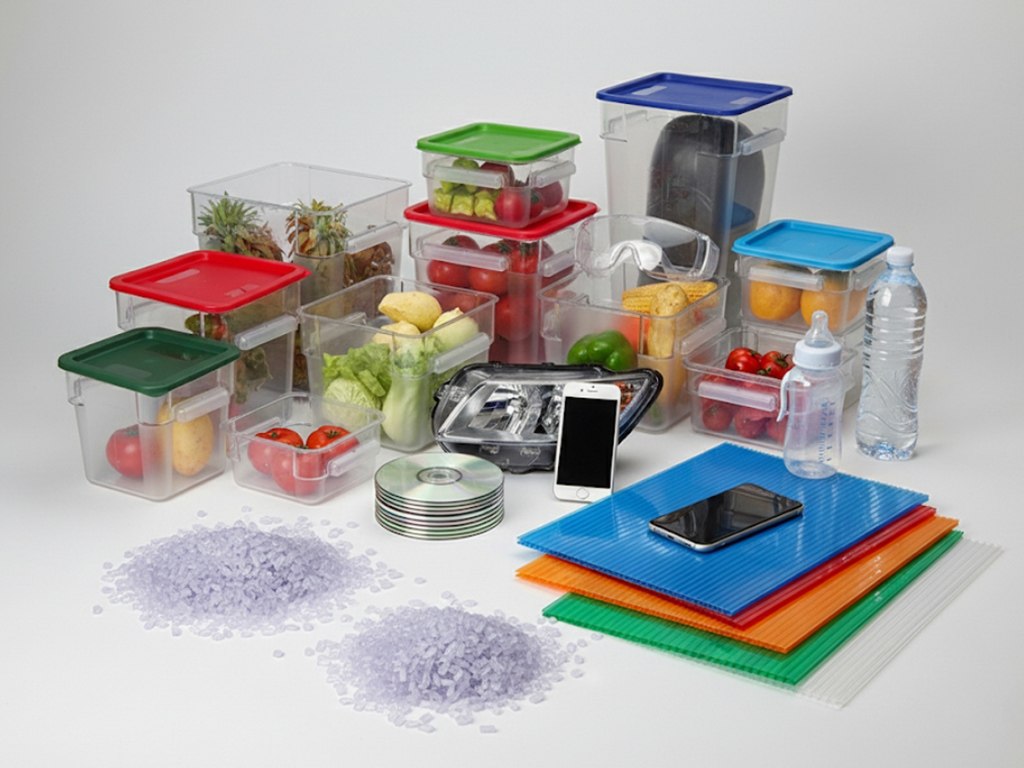
Given the above properties, polycarbonate is widely used across many fields:
- Construction: PC sheets, daylighting panels, skylights, awnings, greenhouses, partitions.
- Electrical & electronics: Outlet housings, switches, covers, connectors, and insulating components.
- Automotive: Headlamp lenses, signal lights, fog-lamp assemblies, and lightweight, durable interior/exterior parts.
- Optics & protective gear: Lenses, safety glasses, face shields, windshields.
- Medical: Trays, sample containers, test tubes, and parts that can be sterilized as specified.
- Optical media: CDs, DVDs, Blu-ray discs.
- Industrial: Machine guards, enclosures, jigs/fixtures, and lightweight mechanical components.
Selection notes for outdoor PC sheets and parts:
- Choose sheets with UV-protective layers on the correct one or two faces for the installation.
- Specify thickness to match span; stiffness rises rapidly with thickness.
- Use compatible fittings and gaskets to avoid stress cracking.
- Clean with neutral solutions or alcohol and a soft cloth; avoid strong alkaline cleaners and aromatic solvents.
Polycarbonate is safe and durable when used correctly and when the right grade is selected. If you need further advice on PC or on other plastics for injection molding, please contact Thai Duong Plastics for support.
Further reading: Pressure forming technology and common materials