

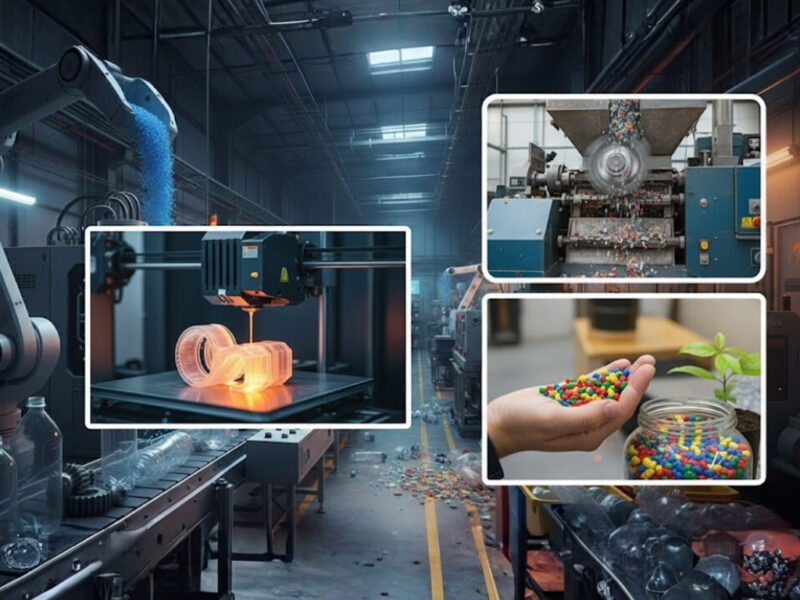
Plastics manufacturing is an industry that synthesizes polymers from petrochemical feedstocks or recycles post-consumer/industrial plastic waste to produce virgin and recycled pellets, then shapes them into finished parts using advanced processing technologies. It is a foundational industry that supplies essential materials to nearly every sector. Follow the article below from Thai Duong Plastics to explore today’s process flow, core technologies, and modern development trends in plastics manufacturing.
Main raw materials in plastics manufacturing
Feedstocks for plastics manufacturing fall into two main groups, each with distinct characteristics and uses:
Virgin resins
Virgin resins are produced from petroleum and natural gas via polymerization reactions. They are highly pure, free of contaminants, typically naturally white, and used in applications requiring strict technical standards such as medical, food contact, and electronics. Common virgin resins include engineering plastic POM, PE, PP, PVC, ABS, PC, PET, and PA.

Recycled resins
Recycled resins are derived from used plastic scrap. After collection, the material is sorted, cleaned, shredded, melted, and re-pelletized. These resins help conserve resources, reduce costs, and protect the environment. However, because their mechanical properties are less consistent than those of virgin resins, recycled resins are typically used for industrial products and non-food-contact packaging.
How does plastics manufacturing work?
The process comprises two major stages: producing polymer pellets and shaping plastic products.
Stage 1: Producing polymer pellets
Step 1: Fractional distillation and cracking
Crude oil and natural gas are distilled to separate light fractions such as ethylene, propylene, and butadiene. These are key monomers (base feedstocks) used to synthesize polymers for industrial plastics.
Step 2: Polymerization
The separated monomers undergo polymerization to form long polymer chains. Depending on reaction conditions and catalysts, this stage yields basic plastics (PE, PP, PVC, PET, ABS, PS, etc.).
Step 3: Pelletizing
The newly formed polymer is cooled and cut into uniformly sized pellets. Pellets are easy to store and transport and serve as the input for the downstream product-shaping stage.
Step 4: Compounding and coloring
Additives (UV stabilizers, heat stabilizers, stiffeners, etc.) and colorants are incorporated into the polymer. This can be performed to create standardized compound pellets or blended directly at the processing machine to improve durability, mechanical performance, and aesthetics.
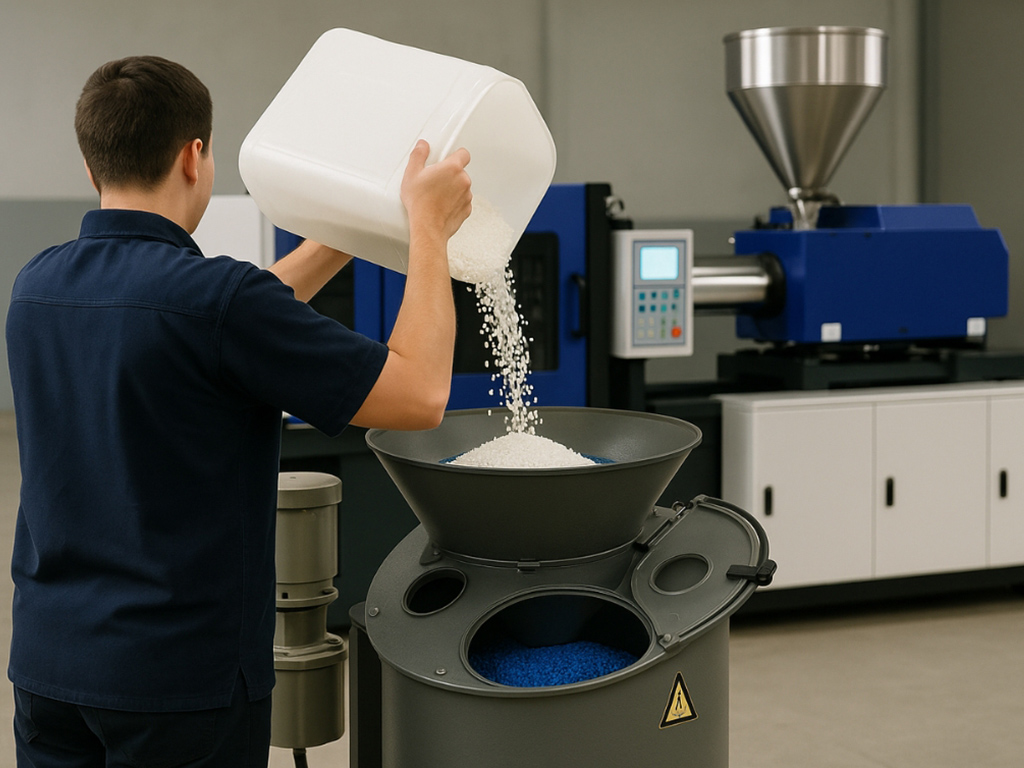
Stage 2: Shaping plastic products
In this stage, qualified pellets enter production lines to be formed according to engineering drawings. Typically, the process starts with material feeding and heating to melt the plastic, which is then shaped in a mold or over a forming surface. Depending on part geometry, size, shape, and technical requirements, companies select suitable processing technologies for optimal results.
Read more: What is plastics processing & common methods
The 6 most common plastics manufacturing technologies
Advances in processing have created a range of methods suited to different materials and end uses. Below are six widely adopted technologies in today’s industry:
Injection molding is the most common technology in industrial plastics production. Pellets are melted and injected into a closed steel mold under high pressure, then cooled to form the part.
- Advantages: High precision, fast cycle times, ideal for complex geometries.
- Applications: Phone housings, automotive components, battery trays, engineering plastic parts.
Plastics extrusion
Molten plastic is continuously forced through a die with a constant cross-section to create tubes, profiles, or sheets.
- Advantages: Continuous production, low cost, minimal material loss.
- Applications: Pipes, sheets, decorative trim, wire/cable jacketing.
Blow molding
A softened parison or preform is inflated with air inside a mold to create hollow products.
- Advantages: Seamless hollow parts, lightweight, high throughput.
- Applications: PET bottles, containers, fuel tanks, hollow toys (products with internal cavities).
Rotational molding
A hollow mold containing plastic powder is rotated biaxially in an oven so the material coats the mold walls uniformly.
- Advantages: Large hollow parts, uniform wall thickness, no weld lines.
- Applications: Water tanks, waste bins, buoys, industrial containers.

Vacuum forming (thermoforming)
A plastic sheet is heated to its forming temperature, then vacuum is applied to draw it tightly against a mold.
- Advantages: Simple tooling, low cost, suitable for small to mid-scale production.
- Applications: Trays, enclosures, packaging, equipment covers.
CNC machining and 3D printing
CNC machining uses automated milling/turning/drilling to cut plastic to precise CAD specifications. 3D printing creates parts by depositing material layer by layer (additive manufacturing).
- Advantages: High accuracy; ideal for prototypes or complex technical components.
- Applications: Jigs and fixtures, technical parts, prototypes, trial molds.
How to choose the right manufacturing process
To maximize efficiency, manufacturers should weigh the following criteria:
- Resin type: Each plastic has distinct mechanical and thermal properties that favor certain processes.
- Part complexity: Complex details favor injection molding; hollow or thin-walled parts suit blow molding or vacuum forming.
- Volume: Injection molding and extrusion suit mass production; 3D printing or CNC suits prototyping.
- Cost and lead time: Balance tooling/equipment investment with production speed.
- Environmental impact: Prioritize recycled resins or bioplastics to meet ESG and ISO 14001 standards.
New trends in plastics manufacturing
The industry is rapidly shifting toward greener, more energy-efficient production. Beyond product quality, companies are reducing environmental impact by innovating both materials and processes.
Bioplastics from renewable sources such as starch, sugarcane, and algae are gradually replacing a portion of conventional plastics, while chemical recycling returns plastic waste to monomers for re-polymerization at near-virgin quality.
At the same time, automation, artificial intelligence, and circular-economy models are optimizing operations, cutting energy consumption, and re-using scrap in-line. This is the inevitable path toward a plastics industry that is more sustainable, efficient, and environmentally responsible.
With the rise of green technologies and sustainable production, choosing a trusted manufacturing partner is vital to ensure quality and efficiency. Thai Duong Plastics is committed to modern, precise, and eco-friendly plastics manufacturing solutions, partnering with businesses to raise productivity and product value.
Further reading: A–Z guide to plastic product molding processes