

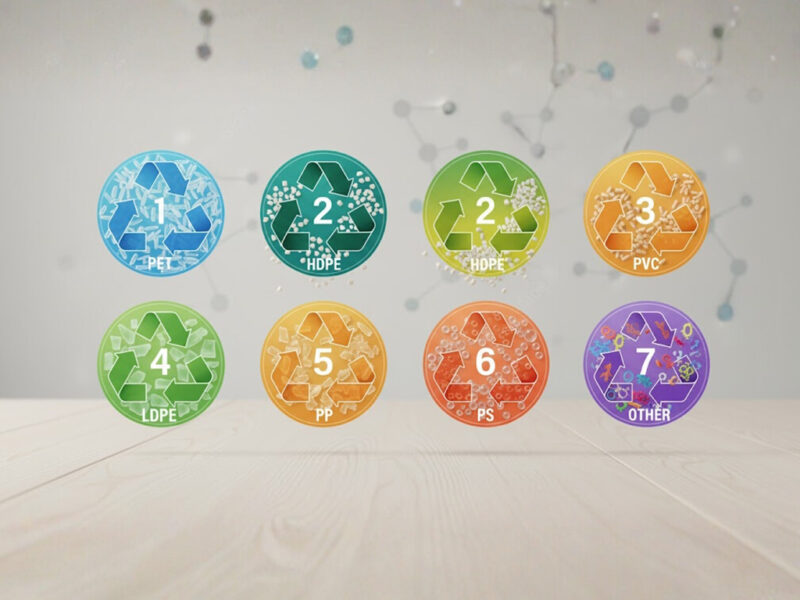
Accurately distinguishing different types of plastics helps consumers use them safely, enables businesses to choose appropriate materials, and improves recycling efficiency across society. With many years of experience in plastic manufacturing and plastic processing, Thai Duong Plastics shares this detailed guide to help you identify, understand the origin and properties of, and correctly use the most common plastic groups in practice.
Why is it necessary to distinguish different types of plastics?
Distinguishing plastics is a critical step in both manufacturing and consumption. For businesses, understanding their properties correctly helps them select suitable raw materials, ensure product quality, and reduce costs. For consumers, recognizing the plastic type allows for safe use, avoiding repeated use of low-durability materials that may pose toxicity risks.
A simple example is that plastic bottles belonging to group 1 should only be used once, whereas plastic containers in group 5 can withstand heat and be reused many times. This awareness helps minimize health risks while reducing the amount of plastic waste generated in daily life.

Classification and identification of basic plastic groups
According to the Resin Identification Code system, plastic products are divided into seven groups (from 1 to 7). Each group has its own physical and chemical characteristics, indicating different levels of safety and recyclability:
- Plastic group no. 1: Polyethylene Terephthalate (PET, PETE)
This group consists of polyester-structured plastics that are transparent, lightweight, and have good mechanical strength. They are commonly used for water bottles and packaging for liquid foods. However, this plastic should only be used once because it can degrade when exposed to high temperatures. It has high recyclability and is the most commonly collected plastic group.
- Plastic group no. 2: High-Density Polyethylene (HDPE)
This group includes high-density plastics that are durable, chemically inert, and impermeable to water. It is considered safe for food contact and can be reused many times without degrading. Typical applications include baby bottles, plastic jerrycans, bottles for cosmetics and detergents, and children’s toys.
- Plastic group no. 3: Polyvinyl Chloride (PVC)
Contains chlorine in its composition, which provides corrosion resistance but can release toxic fumes when heated. It is commonly used in water pipes, electrical cables, and construction materials. It is not suitable for food contact or applications involving high temperatures.
- Plastic group no. 4: Low-Density Polyethylene (LDPE)
Soft, flexible, with good elasticity and low weight. Widely used for plastic bags, film wraps, and thin packaging. It can be recycled, but its properties tend to deteriorate after multiple processing cycles.
- Plastic group no. 5: Polypropylene (PP)
Heat-resistant and chemically resistant, and safe for contact with food. It is lightweight, durable, and maintains its shape well. Commonly used for food containers, bottle caps, cups, and products that may be exposed to short-term heating.
- Plastic group no. 6: Polystyrene (PS)
Lightweight and a good thermal insulator but brittle and easily broken. At high temperatures it may release harmful substances. Used mainly for disposable items such as foam boxes and plastic cups. Recycling this group is relatively difficult and requires dedicated treatment technologies.
- Plastic group no. 7: Other (Other plastics)
A mixed group that includes engineering plastics and bioplastics such as PC, ABS, PLA, and others. Their properties are diverse; some offer high impact resistance or heat resistance, while others are biodegradable depending on their composition. Certain plastics in this group may contain BPA, so it is important to look for the “BPA Free” label before use.

Distinguishing plastics by origin
- Virgin plastic
Produced from petroleum and natural gas, this group currently accounts for the majority of industrial plastic production. Virgin plastics are durable, easy to mold, and inexpensive, but they are very difficult to decompose in the natural environment.
- Recycled plastic
Produced from post-consumer or post-industrial plastics through sorting, cleaning, and pelletizing. Recycled plastics help conserve resources and reduce pollution, but they are only safe when the correct types are reused. Codes 1, 2, 4, and 5 are generally considered suitable for recycling.
- Bioplastic
These materials are made from renewable organic sources and are usually classified within group 7, with typical types including PLA, PHA, and others. Their most distinctive feature is their ability to biodegrade under specific conditions.
Identifying plastics by appearance and thermal behavior
Visual inspection is a simple way to identify plastics:
- Transparent, brittle plastics are often group 1 or 6.
- White, opaque, thick plastics tend to be group 2.
- Soft plastics with a slight sheen are often group 4.
When exposed to heat, different plastics behave differently:
- Groups 1 and 4 soften quickly and emit a faint waxy odor.
- Group 3 produces white smoke with a pungent smell.
- Group 5 has good heat resistance.
- Group 6 burns quickly and produces black smoke.

Distinguishing plastics by material properties
In addition to classification by identification code or origin, plastics can also be distinguished based on mechanical properties and material elasticity:
- Rigid plastics
High mechanical strength, good load-bearing and heat resistance, and low deformation. Used for electronic components, technical equipment, and products that require high dimensional stability. ABS, PC, and PMMA are typical examples.
- Flexible plastics
Soft, easily bent, flexible, and highly recyclable. Commonly used in packaging, plastic bags, tubing, and household products. PE, PP, and PVC are the most widely used representatives.

Distinguishing plastics in recycling and safe use
In recycling processes, plastics are separated by density and thermal properties:
- Light plastics such as PE and PP float on the water surface.
- Heavier plastics such as PET, PVC, and PC sink to the bottom.
This separation helps control the quality of recycled feedstock, avoiding mixing that can make materials brittle and reduce product durability. From a safety perspective, plastics such as PET, PP, HDPE, and LDPE are highly rated thanks to their chemical inertness and stability. PVC and PS should be limited in contact with hot foods, while engineering plastics such as PC and ABS should only be used in industrial applications that are certified “BPA Free.”

Recognizing and correctly distinguishing types of plastics not only helps protect consumer health but also contributes to reducing waste and promoting sustainable recycling. A solid understanding of the nature of each plastic type is the foundation for choosing and using materials responsibly, thereby contributing to a greener future and sustainable development.
Read more: Types of plastics used in injection molding