

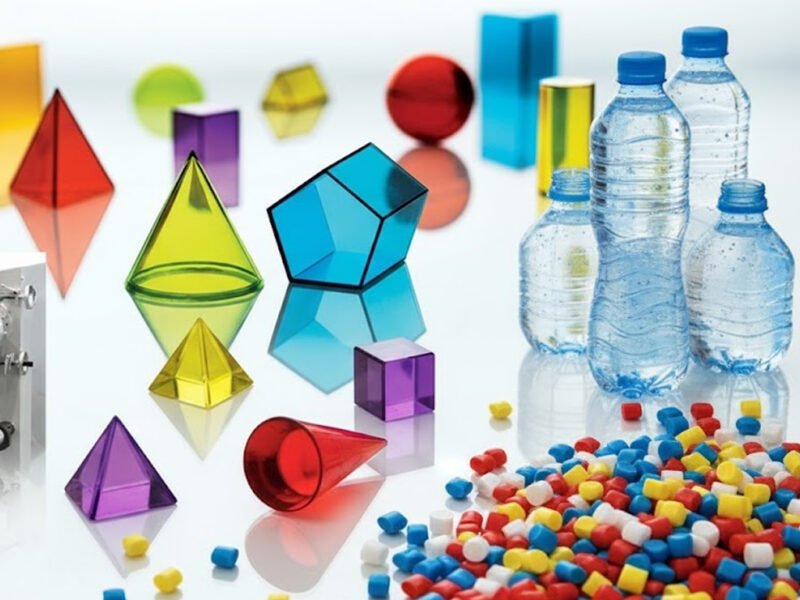
Plastics are widely used across most manufacturing sectors and daily life-such as packaging, engineering components, and electronic devices-thanks to their durability, light weight, and ease of forming. Understanding the properties of plastics helps businesses select the right materials, optimize processing, and produce higher-quality products. In the article below, Thai Duong Plastics will provide an in-depth analysis of the key properties of plastics and their practical roles in manufacturing.
Overview of Plastic Properties
A solid understanding of the plastic properties below will help users, businesses, and engineers:
- Select the appropriate material for each specific application.
- Optimize molding, casting, and cooling processes in production.
- Control quality and extend product lifespan.
- Minimize defects while saving costs and energy.
| Property Table of Some Common Plastics | ||
| Plastic Type | Key Characteristics | Typical Applications |
| PP (Polypropylene) | Lightweight, heat-resistant, excellent fatigue strength | Plastic containers, bottle caps, hinges |
| PE (Polyethylene) | Flexible, corrosion-resistant, low moisture absorption | Plastic bags, storage containers, wrapping film |
| PVC (Polyvinyl Chloride) | Rigid, electrically insulating, chemical-resistant | Water pipes, electrical cables, plastic doors |
| ABS (Acrylonitrile Butadiene Styrene) | Impact-resistant, easy to machine/process | Electronic parts, furniture and interior fixtures |
| PC (Polycarbonate) | Transparent, high strength | Safety helmets, roofing sheets, equipment housings |
| PS (Polystyrene) | Lightweight, thermally insulating, low cost | Foam boxes, plastic cups, packaging |
| Epoxy (EP) | Hard, heat-resistant, strong adhesion | Adhesives, composite materials |
| Phenolic (PF) | High heat resistance and excellent electrical insulation | Electrical tools, handles, engineering materials |
Polymer Structure Determines Plastic Properties
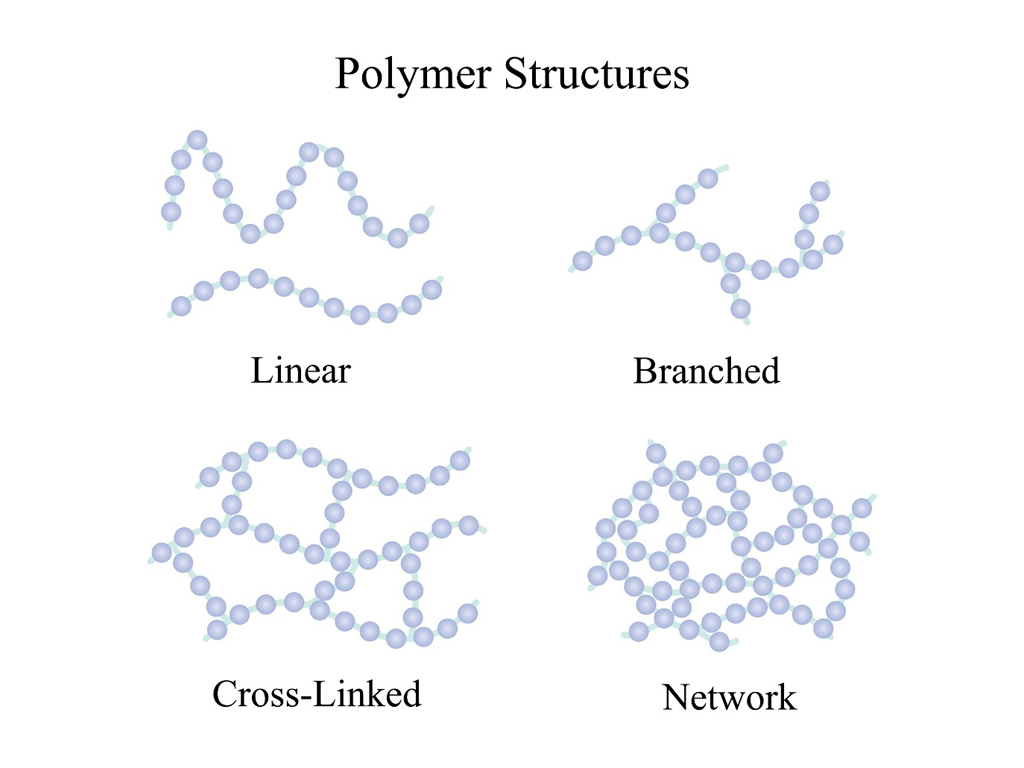
Plastics are made up of polymer molecular chains, where each chain consists of many smaller units called monomers. The structure and bonding of these chains determine the overall characteristics of the material.
Polymers can exist in several different forms. Linear polymers are typically soft, flexible, and easy to bend. Branched polymers offer high flexibility but tend to have lower density. Meanwhile, cross-linked network structures are stable, rigid, and highly heat-resistant-commonly found in epoxy and phenolic plastics.
By simply changing the arrangement or the chain length of a polymer, the properties of a plastic can change completely. This is why plastics such as PE, PP, PC, and others can exhibit very different performance even though they are all polymer-based materials.
Mechanical Properties of Plastics
Mechanical properties reflect a material’s ability to withstand loads, resist impact, and maintain elasticity. Plastics are typically much lighter than metals while still offering considerable strength. Key highlights include:
- High tensile strength and stiffness help plastics carry significant loads without deformation.
- Good elasticity enables bending, shaping, and molding without cracking.
- Low density helps reduce transportation and manufacturing costs.
For example, Polypropylene (PP) has excellent fatigue strength, making it suitable for moving parts such as hinges and flip-top caps. Polycarbonate (PC), on the other hand, offers outstanding impact resistance and is commonly used for safety helmets and protective eyewear.
Thermal Properties of Plastics
Thermal properties reflect heat resistance and how much plastics deform at high temperatures. Based on their response to heat, plastics are classified into two groups:
- Thermoplastics (PE, PP, PVC, PS, etc.) soften when heated, harden when cooled, and can be recycled multiple times.
- Thermosets (Epoxy, Phenolic, etc.) cannot be remelted after curing and shaping; they offer very high strength and heat resistance.
Some plastics such as PC and PPS have high softening temperatures, making them suitable for industrial components. In contrast, plastics like LDPE and PP have lower melting points, which helps save energy during processing.
Chemical Properties of Plastics
Plastics generally have good resistance to chemical corrosion and are less affected by acids, alkalis, or salts. This is why they are used in applications requiring stability and durability. However, chemical inertness also makes plastics difficult to decompose in the natural environment:
- PVC and PE stand out for their chemical resistance and are commonly used for water pipes and construction materials.
- PP can withstand mild organic solvents, making it suitable for packaging and food containers.
- PTFE (Teflon) reacts with virtually no chemicals-even strong acids-so it is used in specialized industries.
Electrical and Optical Properties of Plastics
Most plastics are effective electrical insulators. They do not conduct electricity and are less affected by humidity or environmental conditions, so they are often used in electrical equipment, cables, and device housings.
In addition, some plastics offer exceptional optical performance. PMMA (acrylic) and Polycarbonate (PC) have high transparency, allowing light transmission of up to 90%. Therefore, they are used in the production of lenses, roofing panels, and optical components.
Plastics can also be modified with additives to adjust anti-static properties, UV resistance, or reflectivity depending on technical requirements.
Physical Properties of Plastics
Physical properties include density, moisture absorption, and refractive index.
- Most plastics have low density, typically ranging from 0.9 to 1.5 g/cm3.
- Plastics generally have low moisture absorption, except for certain types such as Nylon, which must be dried before molding.
- A high refractive index gives plastics a glossy surface and makes it easier to achieve transparent or matte effects depending on the design.
With flexible forming capabilities, plastics can be injection molded, extruded, blow molded, printed, and more-allowing products in a wide range of shapes and colors. This is a key reason plastics dominate modern industrial design.
Read more: What Are Synthetic Plastics? Characteristics, Classification, and Applications
Factors Affecting Plastic Properties
Plastic properties are not fixed values; they can change depending on manufacturing conditions and the usage environment.
Some notable influencing factors include:
- Temperature: Too high can degrade polymers, while too low can make products brittle and prone to cracking.
- Injection pressure: Determines density and uniformity of the product.
- Humidity: If not properly dried, plastics may develop bubbles or reduced tensile strength.
- UV and oxygen exposure: Causes aging, discoloration, or increased brittleness over time.

Plastic properties are the foundation for understanding and fully leveraging the potential of this material. Accurately grasping mechanical, chemical, thermal, and electrical characteristics helps optimize production processes while also supporting sustainable use. With many years of experience in manufacturing and processing engineering plastics, Thai Duong Plastics is committed to delivering material solutions that are safe, effective, and environmentally friendly.
See also: What Is Recycled Plastic? Characteristics of Different Types of Recycled Plastics