

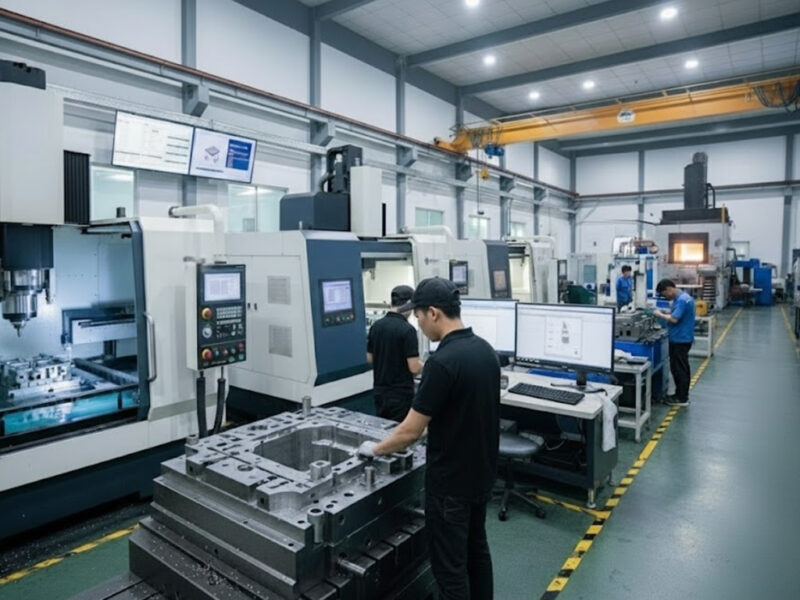
Mold tooling is the foundation of modern manufacturing, playing a critical role in shaping products across most industrial sectors. In this article, we will take a closer look at what a mold is, the production workflow, and the advanced technologies commonly used in mold machining today.
Overview of Mold Tooling
A mold is an engineered tool-typically made from hardened metal-used to form materials during production. When a material (plastic, metal, rubber, etc.) is fed into the mold under heat and pressure, it takes the shape of the mold cavity. The material then cools or solidifies to become a finished product.
Each mold set is custom-designed to match a specific product requirement. Factors such as size, precision, geometry, and mold material depend on the application and production scale. Thanks to high repeatability and accuracy, molds help manufacturers optimize lead time and cost for mass production.
The Role of Mold Tooling in Industrial Manufacturing
Mold tooling is the bridge between design intent and real-world products. A precisely manufactured mold helps ensure dimensional accuracy, consistency, and stable quality throughout the entire production run. Key benefits of mold tooling include:
- Boosting productivity and shortening production time.
- Ensuring high precision and superior aesthetics.
- Optimizing raw materials and reducing scrap.
- Enabling large-scale automated manufacturing.
Common Types of Molds
Mold tooling comes in many forms depending on operating principle, processed material, and final output. Below are some of the most widely used types in industry:
Plastic Injection Molds
Injection molds are used to manufacture engineering plastics and consumer plastic products. Molten plastic is injected into the mold cavity, then cooled, and the part is ejected. This type of mold is suitable for complex geometries that require high precision and an excellent surface finish.
Learn more: Overview of Plastic Injection Molds
Metal Stamping Dies
Stamping dies are used for sheet metal fabrication to create parts such as component housings, machine covers, automotive parts, and mechanical assemblies. A stamping die can perform multiple operations such as cutting, bending, deep drawing, and pressing metal into the desired shape.
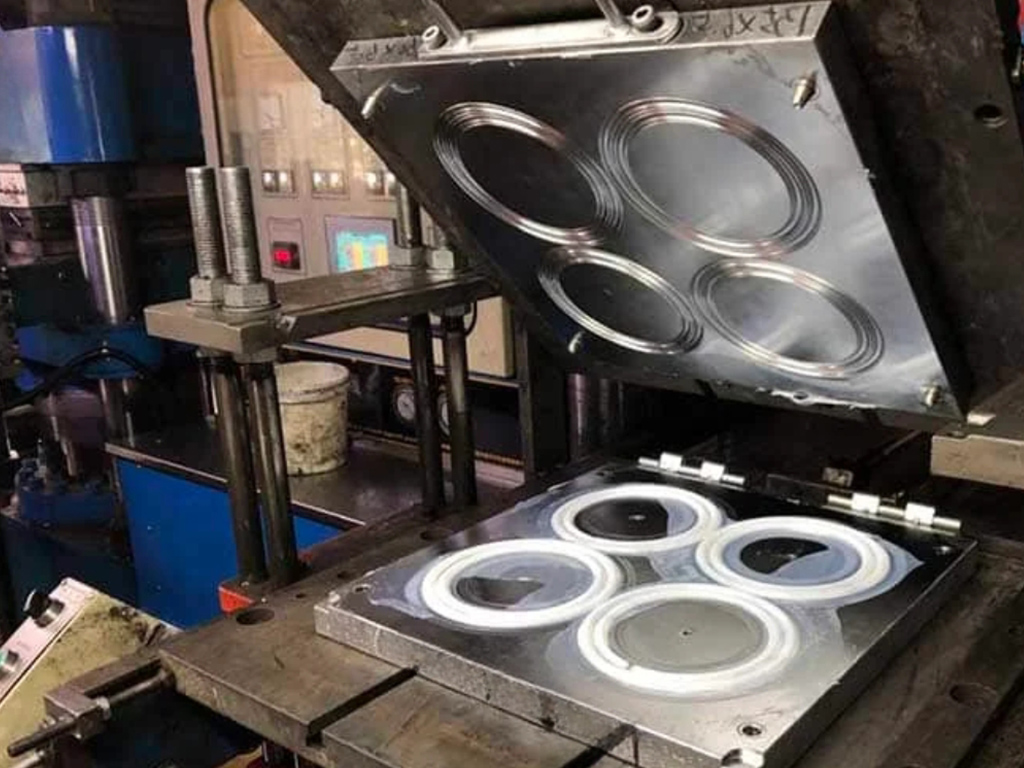
These molds are used to produce technical rubber products such as gaskets, seals, hoses, and anti-vibration pads. Rubber is pressed into the mold and then vulcanized at high temperature to form the shape and improve mechanical strength.
Metal Casting (Die-Casting) Molds
Used for alloys such as aluminum, zinc, and magnesium to produce parts with high accuracy and durability. This method is widely applied in automotive manufacturing, electrical equipment, and precision mechanical products.
Applications Across Industries
Molds are widely used in many different sectors:
- Plastics industry: Engineering plastic parts, housings, packaging, household goods, and electronic components.
- Automotive industry: Interior/exterior trim, engine covers, panels, and structural parts.
- Mechanical engineering: Precision-stamped and cast metal components for machinery and industrial equipment.
- Medical industry: Medical devices, syringes, medicine boxes, and safety accessories.
- Electronics industry: Components, circuit boards, device enclosures, and technical connectors.
- Construction industry: Molds for bricks, plastic panels, pipe fittings, and insulation boards.
The Most Detailed Mold Manufacturing Process
A high-quality mold requires a strict manufacturing workflow that combines precision mechanical engineering with modern simulation technologies. In most cases, the process includes five main steps:
Step 1: Mold Design
Engineers use specialized design software to build a detailed 3D model of the mold. The design must account for critical factors such as mold opening direction, venting, cooling channels, and material shrinkage.
Step 2: Mechanical Machining
Design data is transferred to CNC, EDM, milling, and other machining systems to manufacture each component with high accuracy. This stage largely determines the mold’s durability and performance.

Step 3: Heat Treatment
Mold components are hardened and tempered to improve wear resistance and load-bearing capacity when operating under high temperature and high pressure.
Step 4: Assembly and Inspection
After machining, components are assembled and verified using coordinate measuring equipment (CMM/3D measurement) to ensure tolerances remain within allowable limits.
Step 5: Trial Run and Fine-Tuning
The mold is installed on an injection molding or casting machine for performance testing. After the trial run, engineers evaluate sealing, material filling capability, and then fine-tune key parameters-such as gate position, cooling system, and mechanical components like pistons/ejectors and locating pins-to achieve optimal quality before mass production.
Modern Technologies Applied in Mold Machining
The rise of digital technology and automation has driven major advancements in the mold industry:
CAD, CAM, and CNC Technologies
These three technologies combine to create a closed-loop production workflow, reducing manual errors and improving efficiency:
- CAD supports detailed mold design with accurate, visual 3D modeling.
- CAM converts design data into machine control programs.
- CNC enables automated machining with ultra-tight tolerances and stable quality.
- EDM is particularly effective for machining complex cavities, sharp corners, or hardened materials that conventional milling struggles to process.

Laser Engraving Technology
Laser engraving enables high-precision patterns, markings, and surface treatments on molds. This method minimizes material wear and helps maintain durability and aesthetics throughout the mold’s service life.
Moldflow Simulation Software
Moldflow simulation helps predict how material will fill the mold cavity, allowing engineers to detect issues early-such as air traps and shrinkage. Simulating before machining saves time and reduces trial-and-error costs.
3D Scanning and Measurement Technology
3D scanning equipment is used to verify mold geometry and dimensions, ensuring a precise match between the design and the actual manufactured mold.
Trends in the Mold Industry
The mold industry is moving toward smart manufacturing and end-to-end automation. Notable global trends include:
- Applying AI and IoT sensors to monitor molds in real time.
- Using new mold materials with better thermal conductivity and higher wear resistance.
- Advancing metal 3D printing to produce complex mold components.
- Building smart mold factories to reduce lead time and improve accuracy.

Mold tooling is fundamental to industrial manufacturing-improving productivity, optimizing cost, and ensuring product accuracy. With extensive experience in industrial plastic injection molding, Thai Duong Plastics is committed to delivering end-to-end solutions from design and machining to mold trials-meeting strict technical standards and high aesthetic requirements across industries.
See more: Precision Mold Machining & Plastic Injection Mold Manufacturing, Down to Every Detail