

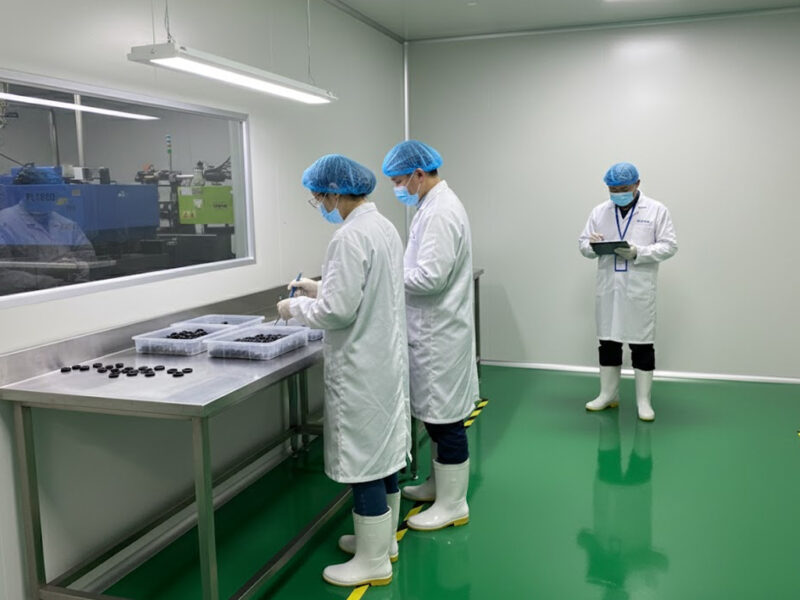
In rubber manufacturing, airborne particulate contamination directly affects visual appearance, surface cleanliness, and the packaging quality of finished goods. ISO Class 8 cleanrooms-equivalent to Class 100,000-are widely adopted by many factories as a baseline environmental control solution for specific production steps. Drawing on experience implementing cleanroom setups for technical rubber lines, Thai Duong Plastics shares key information and guidance on how to apply ISO Class 8 at the right points in the production line to improve quality control while optimizing operating costs.
What is ISO Class 8 in the cleanroom context?
ISO Class 8 is an air cleanliness classification level under ISO 14644-1. “Class 100,000” is the equivalent term used under the former FED STD 209E standard. Since 2001, the ISO 14644 system has replaced FED STD 209E; however, both terms are still commonly used in cleanroom design and operation.
Under ISO 14644, ISO Class 8 cleanroom manufacturing is controlled according to the following particle limits:
- Particles >= 0.5 micrometres: Maximum 3,520,000 particles/m3.
- Particles >= 1 micrometre: Maximum 832,000 particles/m3.
- Particles >= 5 micrometres: Maximum 29,300 particles/m3.
In ISO Class 8, particles smaller than 0.5 micrometres are not required to be counted. Control and periodic qualification typically focus on particles from 0.5 micrometres and above. In rubber manufacturing, ISO Class 8 cleanrooms are commonly applied in areas such as:
- Visual inspection and product measurement/verification.
- Sorting and assembly of rubber components.
- Final packaging and storage of clean packaging materials.
This class level provides more effective baseline dust control than a typical workshop environment, while optimizing costs compared with higher cleanroom classes. However, Class 100,000 / ISO Class 8 is generally considered “clean enough” only when applied to final finishing steps of the line, and it is not suitable for high-dust processes or areas requiring stringent control.
Why does rubber manufacturing need ISO Class 8?
In rubber manufacturing, defects related to dust particles and surface contamination often become most visible near the end of the production line. Especially for products with strict requirements for appearance, seal integrity, surface cleanliness, and packaging stability, environmental control is a non-negotiable factor.
Many companies choose ISO Class 8 because it balances control level with investment cost. Key benefits of applying ISO Class 8 in rubber manufacturing include:
- Reducing appearance defects caused by dust adhering to product surfaces after molding.
- Limiting cross-contamination between material lines such as black rubber, white rubber, silicone, and technical rubber.
- Stabilizing quality in inspection, measurement, sorting, assembly, and packaging steps.
- Reducing the risk of paper dust, textile fibers, and foreign particles contaminating packaging, trays, and bags.
- Supporting customer quality management requirements-especially for technical rubber products and baseline-level rubber parts used in medical devices.
Note that ISO Class 8 controls airborne particle concentration. This standard does not directly evaluate odors, solvent vapors, VOCs, etc. For lines with chemical emissions, the HVAC system should be additionally designed to provide appropriate control.
Is ISO Class 8 suitable for every rubber molding process?
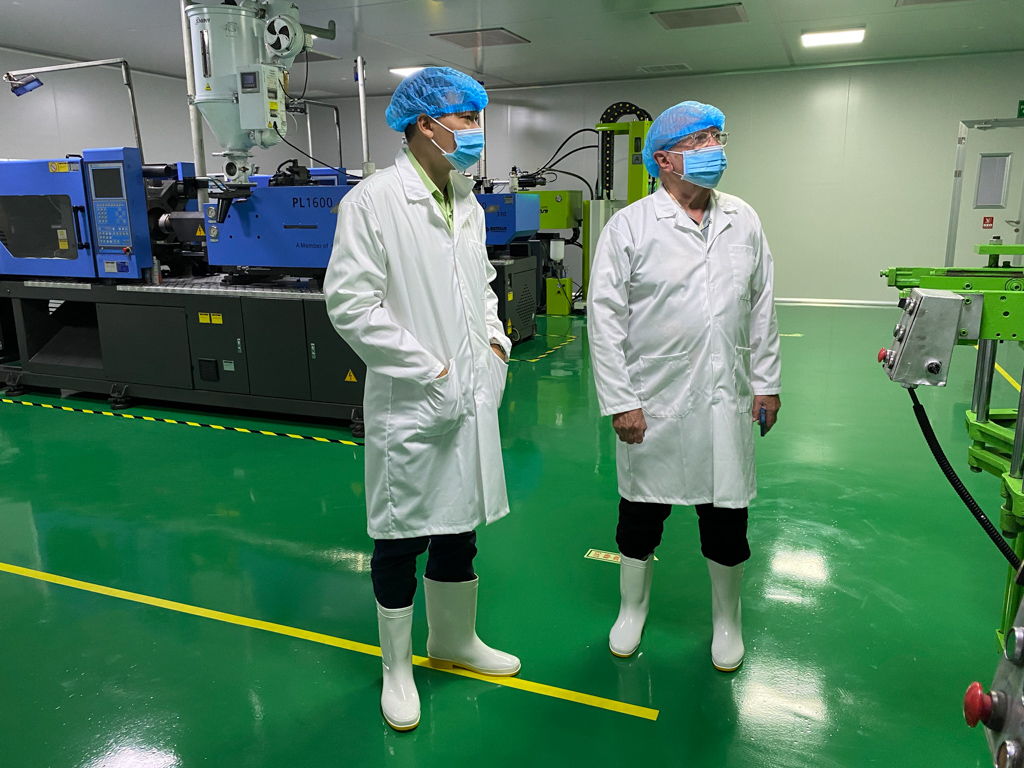
In practice, not every step in rubber production is suitable to be fully placed inside an ISO Class 8 cleanroom. The engineering principle is to apply ISO Class 8 only to operations where product quality is strongly affected by dust, while the process’s inherent dust generation remains within controllable levels.
Processes that are typically suitable to be arranged within ISO Class 8:
- Visual inspection and dimensional measurement of seals, oil seals, O-rings, and technical rubber parts.
- Assembly of rubber components with sub-assemblies when surface cleanliness is required.
- Final packaging, sealing, tray packing, bagging, and vacuum packing (if applicable).
- Storage areas for clean packaging materials, clean trays, and consumables that directly contact the product.
- Selected post-molding cleaning steps, depending on internal standards and customer requirements.
Processes that should not be placed in a full-room ISO Class 8 environment:
- Weighing, batching, and compounding with high filler powders such as carbon black and silica.
- Internal mixing in a kneader, milling, and open-roll processing.
- Mechanical trimming, grinding, or deflashing, which generates very high dust levels.
- Areas for carton boxing, palletizing, and handling of raw paper materials.
For high-dust processes, a more effective approach is to separate them into dedicated areas, control dust at the source with local exhaust systems, and organize personnel/material flows to avoid bringing dust into ISO Class 8 areas.
How to apply ISO Class 8 in cleanroom rubber production
In rubber molding lines, contaminants often adhere to products during mold opening, part removal, light trimming, tray placement, and transfer to inspection. Therefore, a common and effective layout model is:
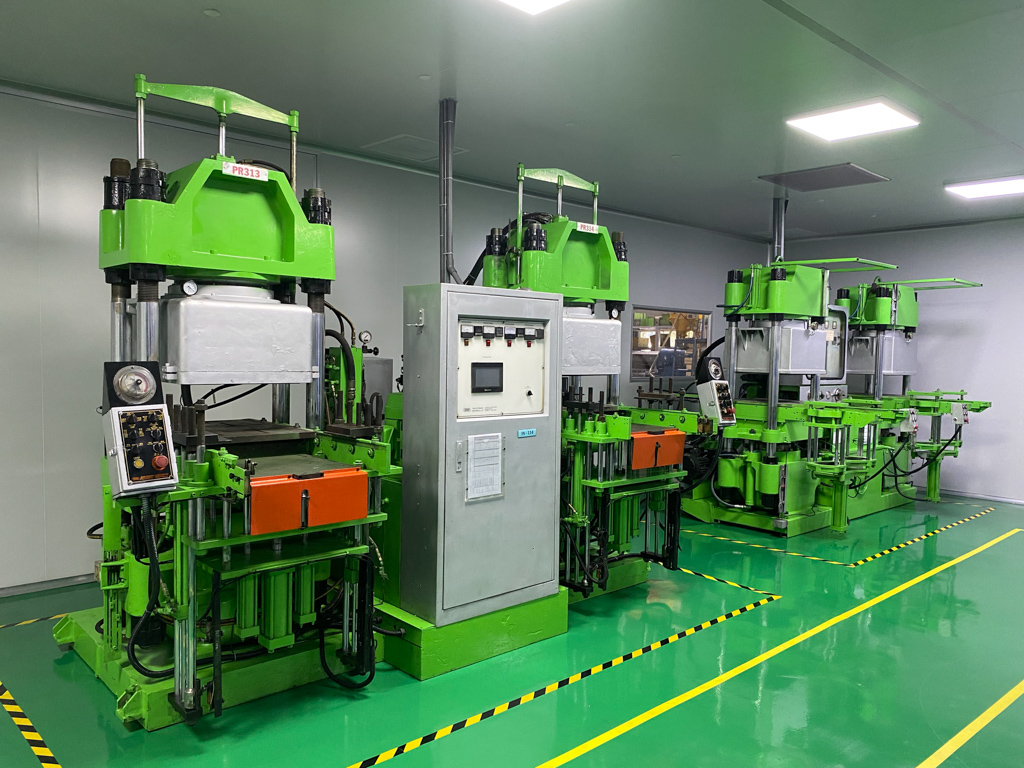
- The molding area is controlled at a moderate cleanliness level, focusing on airflow, housekeeping, and reducing dust sources.
- The inspection, sorting, and packaging area is placed inside an ISO Class 8 cleanroom to “lock in” outgoing quality.
With rubber injection molding, although feeding and mold closing are more stable, dust can still arise from part handling, flash trimming knives, trays/containers, and human movement. Therefore, post-molding and packaging areas remain the primary control focus under ISO Class 8.
Technical and operational requirements for an ISO Class 8 cleanroom
To operate an ISO Class 8 cleanroom stably in a rubber production environment, technical and operational requirements must be controlled as an integrated system across the following key groups:
Air handling system and HEPA filtration
- Design the HVAC system based on the actual dust load of the rubber production line.
- Use H13 or H14 HEPA filters, with efficiency around 99.97% at a particle size of 0.3 micrometres.
- Implement a multi-stage filtration train (pre-filter, fine filter, HEPA) to reduce HEPA loading and extend filter life.
- FFUs or HEPA terminal units at the final supply point may be used depending on the cleanroom structure.
Air change rate
- Typical air changes per hour are in the range of 10 to 20 ACH.
- Determine airflow based on personnel density, entry/exit frequency, and product sensitivity.
- For finishing and packaging areas, prioritize design based on actual load to maintain environmental stability.
Differential pressure and pressure cascade
- Maintain positive pressure relative to adjacent areas, commonly around 10 Pa.
- Define a proper pressure cascade between clean areas, buffer/intermediate areas, and high-dust zones.
- Reduce the risk of reverse contamination during operation.
Temperature and humidity conditions
- Cleanroom temperature is typically maintained between 20 and 24°C.
- Relative humidity ranges from 45% to 65%.
- Adjust setpoints based on rubber material characteristics, anti-static requirements, and personnel comfort/work conditions.
Layout, flow segregation, and material control
- Implement one-way flow for people and materials, minimizing cross-traffic.
- Use an anteroom/airlock to stabilize pressure during entry/exit.
- Use door interlocks to prevent simultaneous opening and pressure drop.
- Install pass boxes to transfer materials and reduce door traffic.
- Tightly control items brought into the cleanroom-especially cartons, pallets, and raw packaging-since these are major dust sources.
Finishing materials and auxiliary cleanroom equipment
To keep an ISO Class 8 cleanroom sustainable, the room must be easy to clean, generate minimal secondary dust, and minimize adhesion. This is highly practical in rubber manufacturing because fine dust and additives can accumulate on surfaces over time.
Materials and construction elements
- Wall and ceiling panels with flat, sealed surfaces and minimal gaps.
- Rounded coves at wall bases and ceiling corners to reduce dust buildup and facilitate cleaning.
- Self-leveling epoxy floors or PVC flooring selected to match load capacity and anti-static needs.
- Sealed doors with gaskets, preferably configured to help maintain stable differential pressure.
Common auxiliary equipment
- Air showers at clean-area entry points when higher control is needed for dust on clothing.
- Pass boxes for materials and samples to reduce door opening and flow crossovers.
- Tacky mats at transition points.
- Easy-to-clean stainless-steel benches and chairs that minimize particle generation.
- Monitoring systems for differential pressure, temperature, and humidity-and when needed, point-based particle monitoring.
For some product lines, electrostatic control should also be considered because static increases particle adhesion to surfaces. In that case, select suitable floor materials and add charge neutralization measures as needed.
Commissioning and periodic qualification for an ISO Class 8 cleanroom
To confirm that a cleanroom meets ISO Class 8, companies should perform initial commissioning and periodic qualification in accordance with ISO 14644. Common verification items include:
- Particle counting to confirm ISO Class 8 classification under ISO 14644-1.
- Checking differential pressure between zones.
- Checking airflow volume and airflow direction.
- Performing test methods under ISO 14644-3.
- Evaluating design and operational requirements under ISO 14644-4 for new projects or renovations.
In practice, many factories apply a maximum 12-month qualification cycle for core items, combined with continuous monitoring of operating parameters to detect deviations early.
Class 100,000 / ISO Class 8 cleanrooms are a suitable solution for rubber manufacturing when dust control and quality stability are required. Applying the standard in the right locations within the production line and designing an appropriate HVAC system help optimize investment efficiency and maintain long-term stable quality. Contact Thai Duong Plastics for consultation on an ISO Class 8 cleanroom solution that fits your needs.
See more: Custom industrial rubber molding