

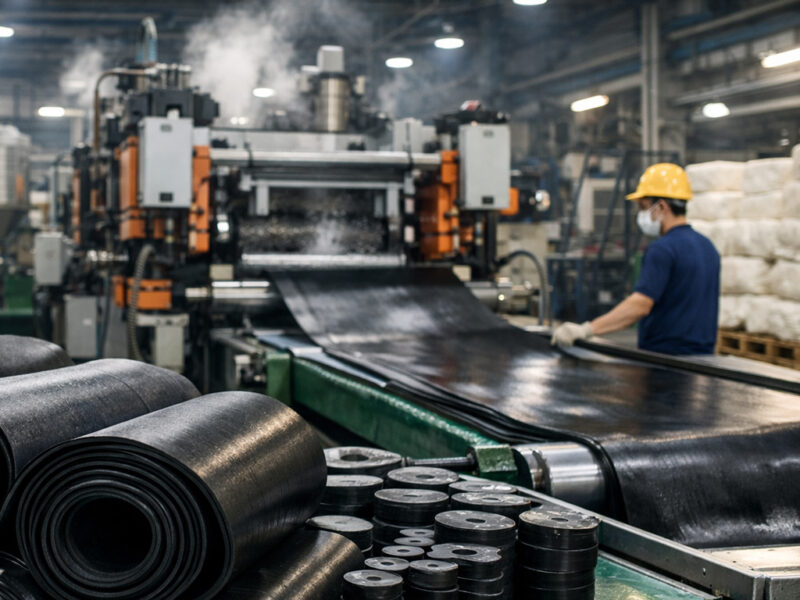
The quality of rubber products comes not only from technical expertise, but also from risk-management capability and production records. In the article below, Thai Duong Plastics analyzes how the ISO 9001:2015 system operates in a rubber factory to help businesses maintain consistent quality, reduce recurring defects, and meet stringent customer requirements.
What is ISO 9001?
ISO 9001 is a quality management system standard, not a technical standard that specifies what tensile strength or hardness a product must achieve. ISO 9001:2015 provides a management framework that helps businesses establish processes, control documents, measure performance, and drive continual improvement in order to produce stable and consistent products.
In a rubber factory, ISO 9001 focuses on the following core areas:
- Process-based management: Clearly defining inputs, outputs, control criteria, and responsibilities for each stage.
- Risk-based thinking: Identifying risks that may lead to nonconformities and taking preventive action before defects occur.
- Evidence-based management: All critical controls must be supported by records for traceability, analysis, and improvement.
Why does the rubber industry need ISO 9001?
The Vietnamese rubber industry in particular, and the global rubber industry in general, is characterized by significant variation between raw-material batches and processing conditions. Many defects arise from small deviations that can strongly affect appearance and sealing performance. Without a consistent control system, defects are likely to recur and root causes become difficult to trace.
Reasons why rubber factories should implement ISO 9001 include:
- Controlling batch-to-batch variation in rubber compounds, additives, curing agents, fillers, and base materials.
- Stabilizing molding and vulcanization parameters to avoid under-curing, over-curing, surface scorching, air voids, and mold sticking.
- Reducing the risk of material mix-ups between product lines such as NBR, EPDM, silicone, black rubber, and white rubber.
- Improving traceability from raw materials to finished products, which is especially important for technical products and products requiring full delivery documentation.
- Creating a solid foundation for supplier evaluation, customer audits, and contract-based quality requirements.

Implementing ISO 9001 at each stage of the rubber production line
For ISO 9001 to truly create value, the quality management system must be translated into clear control points at each manufacturing stage. An effective approach is to build a process map for the entire factory, identify the product’s critical quality characteristics, and define the process parameters that directly affect those characteristics.
Below is how ISO 9001 can be implemented according to the practical control logic of a rubber processing line:
Incoming raw-material control
Rubber raw materials and additives naturally vary from batch to batch. If incoming materials are not tightly controlled, all downstream operations will be exposed to risk. The factory should implement the following core controls:
- Evaluate and approve suppliers based on technical capability and quality consistency.
- Define technical criteria for each type of raw material.
- Perform incoming inspection using specified methods and frequencies.
- Manage batch identification to ensure traceability.
Only raw-material batches that meet requirements should be released to production. Nonconforming batches must be segregated and handled according to procedure.
Formula and compounding process control
The compounding stage determines the uniformity of the rubber compound. Small deviations in weighing or mixing conditions can lead to changes in hardness, tensile strength, cure behavior, and more. Required controls include:
- Formulations must be officially issued and tightly change-controlled.
- Weighing must be recorded for each batch using designated forms.
- Mixing sequence, time, and temperature must be controlled.
- Approval is required for any material or composition changes.
All changes must be risk-assessed before implementation. This is a key requirement under the risk-based thinking approach of ISO 9001.
Mastication and preform preparation control
After compounding, the mastication and milling process affects filler dispersion and the overall uniformity of the rubber compound. The following factors should be controlled:
- Processing time.
- Roll temperature and mixing chamber temperature.
- Criteria for identifying whether the compound meets requirements.
Nonconforming preforms must be identified and segregated to prevent them from entering mass molding operations.
Molding and vulcanization control
This is the stage that determines the shape, dimensions, and mechanical properties of the rubber product. Critical parameters typically include:
- Mold temperature.
- Vulcanization pressure.
- Clamping force.
- Mold-closing speed.
Each product code should have a standard process specification. During production, actual parameters must be recorded by batch. When molds are changed or parameters are adjusted, technical approval is required before production continues. Controlling this stage helps reduce defects such as under-curing, over-curing, dimensional deformation, and air voids.
Finishing and appearance control
Finishing operations such as flash trimming and cleaning directly affect appearance and sealing performance. It is necessary to clearly define:
- Appearance criteria.
- Flash-removal methods.
- Product classification methods.
Effective control at this stage helps reduce the defect rate detected during final inspection.
Final inspection and traceability control
Before shipment, products must be inspected according to defined acceptance standards. The factory should ensure:
- Measuring equipment is calibrated periodically.
- Inspection results are recorded by batch.
- Nonconforming products are clearly segregated and handled.
- Batch labels and production records allow backward traceability to raw materials and process parameters.
Complete traceability is a key requirement of ISO 9001 and also enables rapid response in case of complaints.

The minimum ISO 9001 documentation a rubber factory should have
To keep the system lean, a rubber factory does not need excessive documentation, but it does need the right core documents to control risks and provide evidence.
System management documents:
- Quality policy and quality objectives.
- Documented information control procedure, including issuance, revision, and withdrawal.
- Risk and opportunity management procedure based on the factory context.
- Internal audit and management review procedure.
Operational and quality-control documents:
- Supplier evaluation and supplier management procedure.
- IQC, IPQC, and OQC procedures suitable for rubber products.
- Nonconforming product control procedure, including segregation, classification, rework, and conditional-use approval if applicable.
- Batch traceability procedure, including batch code rules, labels, tags, and supporting records.
- Calibration and measuring-equipment control procedure, covering rulers, micrometers, hardness testers, scales, and test equipment.
- Change-management procedure, applied to formulas, raw materials, molds, parameters, line layout, and suppliers.
Implementation records used on the shop floor, which often determine whether the system is truly applied and maintained effectively:
- Batch-based material weighing and issuance records.
- Compounding and compound preform monitoring sheets.
- Machine setup and molding/vulcanization parameter records.
- First-piece approval records for shift start and batch start.
- Product appearance and dimensional inspection sheets.
- Nonconformity handling and corrective/preventive action records.
- Batch-based delivery records, including inspection results and traceability labels.
Recommended quality KPIs for ISO 9001 in rubber manufacturing
KPIs under ISO 9001 should accurately reflect quality performance and process stability. When selecting KPIs, they should be measurable, supported by reliable data, and assigned to a responsible owner. Common KPIs suitable for rubber factories include:
- Defect rate by batch and by process stage, calculated as a percentage or in PPM if required by the customer.
- First Pass Yield (FPY), which reflects process stability and reduced rework.
- Scrap rate and rework rate, separated by causes such as flash, scorch, air voids, short shots, and dimensional errors.
- Customer complaint rate and corrective-action closure time.
- Error rate caused by mix-ups, including wrong material, wrong batch label, wrong packaging, and wrong mold.
- Compliance rate for scheduled measuring-equipment calibration and the rate of deviations detected due to measuring equipment.
How does ISO 9001 integrate with ISO Class 8 cleanrooms?
For specialized sectors such as medical rubber, food-contact rubber, and precision electronic components, ISO 14644-1 (ISO Class 8) is often applied to final inspection and packaging areas to control airborne particle levels. When combined with ISO 9001:2015, the cleanroom not only meets requirements at the time of qualification, but is also maintained in a stable operating state through a system of procedures and tightly controlled evidence.
ISO 9001 helps maintain the cleanroom condition by controlling three key areas:
- Clearly defining operating methods, including cleaning, personnel flow, and material flow.
- Periodically monitoring technical parameters such as differential pressure, temperature, humidity, and filtration system maintenance.
- Thoroughly handling nonconformities when signs of contamination appear in order to identify root causes and prevent recurring cosmetic defects.
Learn more: ISO Class 8 in rubber manufacturing
Procedure for applying ISO 9001 in rubber manufacturing
For fast and effective implementation, it is best to follow a roadmap from high-risk to low-risk areas, prioritizing the stages that generate the most variation and defects:
- Assess the current situation and define the scope of application, including products, production lines, warehousing, inspection, and packaging.
- Create a process map for rubber manufacturing and identify critical control points, together with acceptance criteria and measurement methods.
- Standardize the necessary documents, focusing on formula control, change control, batch traceability, nonconformity control, measuring-equipment calibration, and in-process quality inspection.
- Train personnel and conduct controlled trial operation to ensure employees understand both the procedures and the reasons for recording data.
- Collect KPI data, evaluate process effectiveness, and carry out corrective actions when deviations occur.
- Conduct internal audits and management review to finalize improvement points before moving on to certification assessment if the company has that objective.
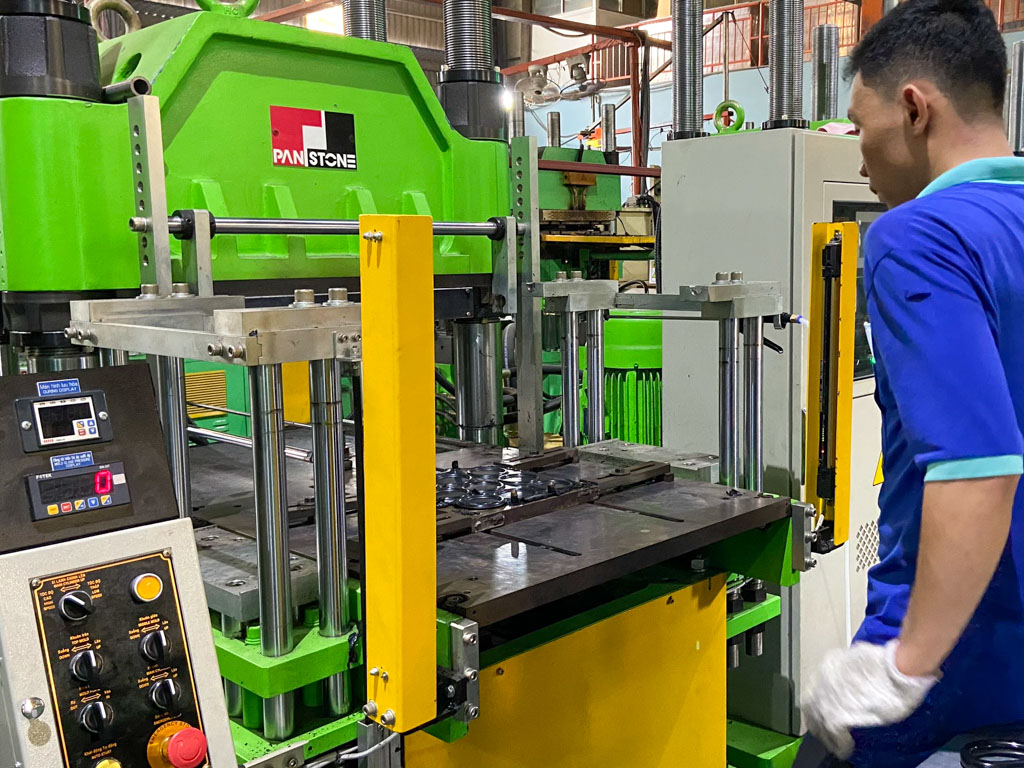
ISO 9001 in industrial rubber molding is a way to standardize processes and evidence in order to reduce batch-to-batch variation, improve traceability, and control recurring defects. When implemented correctly at each process stage and supported by suitable KPIs, businesses can improve quality stability without making the system burdensome.