

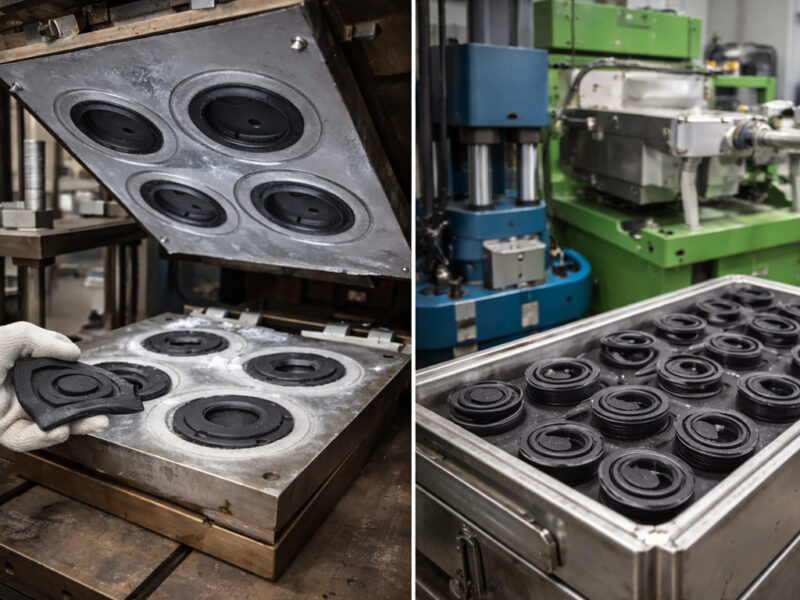
In technical rubber manufacturing, the choice of molding technology directly affects product quality, scrap rate, productivity, and total operating cost. Two common approaches are hot-mold molding and cold-mold molding. Each option fits a different group of products, rubber compounds, and production scales. In the article below, Thai Duong Plastics helps you clearly analyze the principles, pros and cons, and selection criteria to optimize long-term efficiency.
Overview of hot-mold rubber molding
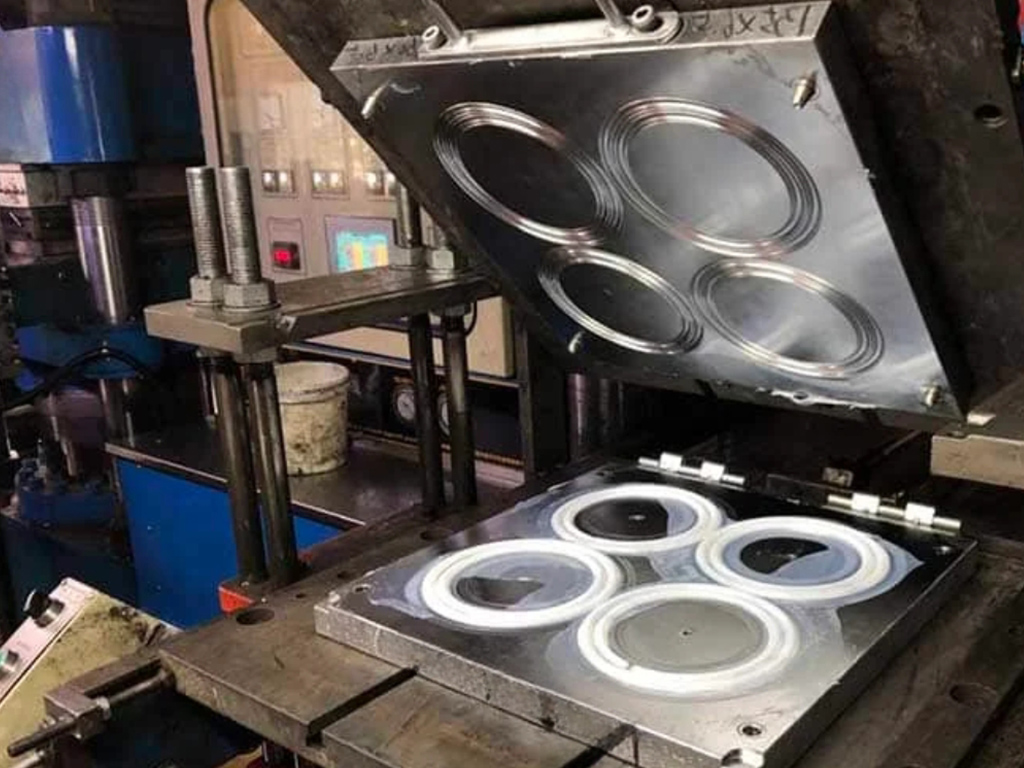
Hot-mold molding refers to a group of processes in which the mold is heated so the rubber vulcanizes (cures) directly inside the cavity. This solution is commonly used in rubber compression molding and transfer molding, and it can also be applied in certain rubber injection molding configurations where both the feeding system and the cavity operate at high temperature to support curing.
During the molding cycle, rubber is placed into the mold cavity or a pot/chamber, then subjected to pressure and heat to trigger vulcanization. After the cure time, the mold opens to remove the part, and flash (excess rubber/parting-line burr) is trimmed and cleaned if present.
Advantages
Hot-mold molding is widely chosen because it offers a strong balance between investment cost and flexibility:
- Mold-making cost is often lower than cold-runner solutions in rubber injection molding, because the mold structure and temperature-control system are less complex.
- Compatible with many rubber materials such as EPDM, NBR, NR, SBR, CR, HNBR, silicone, etc., depending on the formulation and cure requirements.
- Easy to switch products and part numbers, which is suitable for small-to-medium orders or prototype/development phases.
- Easier maintenance and repair, with less dependence on specialized temperature-control modules in the runner/channel region.
- Can handle thick and relatively large parts effectively, where heat transfer time is naturally the main driver of the cycle.
Disadvantages
Despite its production benefits, this technology has limitations that should be carefully considered during selection and implementation:
- Cycle time is typically longer because the material needs time to absorb heat and fully cure, especially for thick parts.
- Flash and scrap rates are often higher, because the process relies on sealing and venting the cavity; flash must then be trimmed and cleaned.
- Automation levels are usually lower than cold-runner rubber injection molding, so labor cost and shift-to-shift consistency may be less favorable.
- Part-to-part consistency across shots depends heavily on feeding operations, preform distribution, mold temperature, and operating conditions.
- For parts with high cosmetic requirements, parting lines and flash marks may require additional finishing.
Overview of cold-mold rubber molding
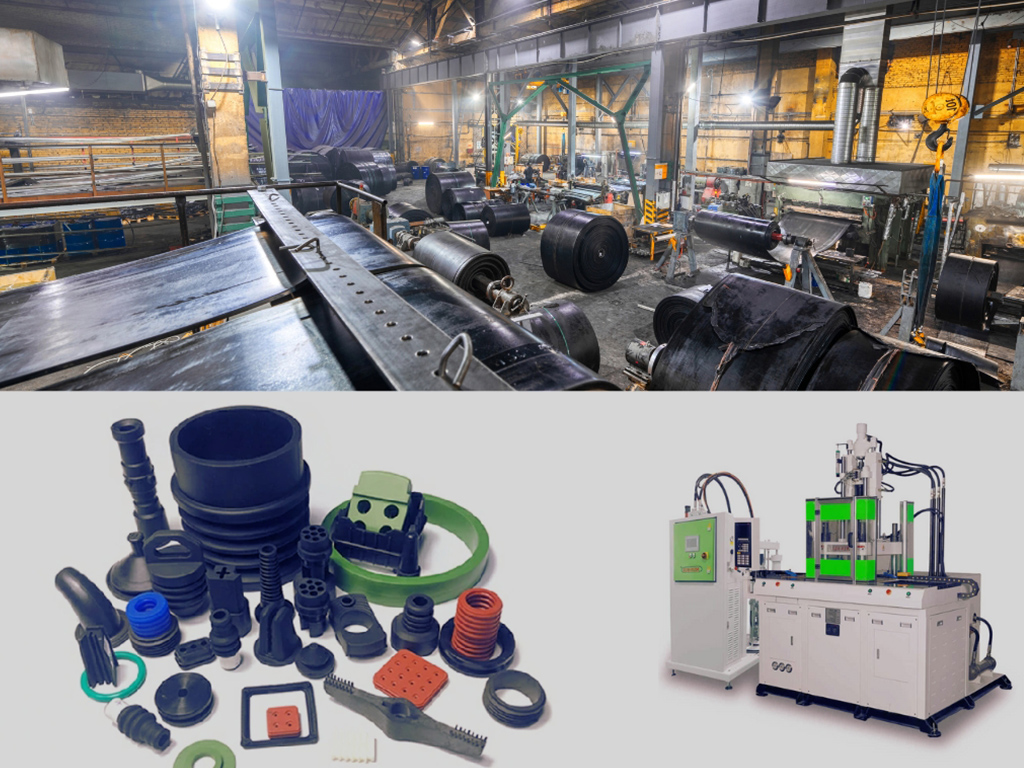
In rubber processing, “cold-mold” typically refers to rubber injection molding using a cold runner system, also known as a cold runner, cold deck, etc. The core idea is to keep the material in the runner and nozzle region in an uncured state, while the cavity region is heated so curing occurs quickly after the material fills the cavity.
Unlike thermoplastics, “cold” here is not intended to solidify the material. The goal is to delay vulcanization in the runner system, preventing premature cure that can cause blockage, reduce stability, and increase scrap.
Advantages
Cold-mold molding is most effective when productivity, automation, and scrap control are top priorities:
- Significantly reduces material waste by minimizing cured rubber in the runner system, thereby reducing scrap and trimming operations.
- Shorter and more stable cycle times due to automatic feeding, fast filling, and curing primarily occurring in the cavity.
- More consistent quality shot-to-shot, supporting tight tolerances and low defect rates in mass production.
- Optimized for automation, reducing reliance on manual operations, which improves shift consistency and lowers labor costs.
- Often improves appearance by controlling the material entry point and reducing flash, especially with well-optimized gate and vent designs.
Disadvantages
While it delivers high productivity and stronger quality control, cold-mold molding requires higher technical capability and higher upfront investment:
- Higher mold and system costs due to the cold runner assembly, precise temperature control, and optimized design to prevent premature curing.
- Design and operation require experience-especially in flow balancing, gate layout, venting, and temperature control in the runner region.
- Specific failure risks if thermal management is incorrect-most commonly premature cure in the runner/nozzle, causing blockage, short shots, and higher scrap.
- Less efficient for small orders, frequent part changes, or multi-iteration testing phases, because mold optimization and process setup time are typically greater.
- Requires compatible molding machines and stable control systems; without aligned equipment infrastructure, expected efficiency may be difficult to achieve.
So, should you choose hot-mold or cold-mold rubber molding?
No single molding technology fits every case, because each method performs differently depending on the product, rubber compound, and production scale:
Cases that are suitable for hot-mold rubber molding
If a project prioritizes flexibility, lower initial tooling investment, and the ability to run multiple part numbers, hot-mold molding is often the better fit:
- Small-to-medium volumes, many product codes, frequent mold and part-number changes.
- Large parts with not overly complex geometry, thick sections where cure time dominates the cycle.
- Development-stage projects requiring prototypes, design revisions, material changes, and frequent hardness adjustments.
- Tooling budget optimization, fast deployment, and simple maintenance requirements.
Cases where cold-mold rubber molding is worth choosing
If the goal is mass production, stable quality, and waste reduction, cold-mold molding is often worth the investment:
- Large volumes with long-term stable production, requiring lower scrap rates and reduced flash-trimming operations.
- High tolerance and uniformity requirements, especially for technical parts with tight control of dimensions and mechanical properties.
- Need for automation to reduce labor, increase stability, and simplify quality control to standards.
- High-cost materials or parts where reducing material loss delivers strong long-term economic benefits.
Evaluate the choice based on total lifecycle production cost
To avoid making a subjective decision, evaluate total cost of ownership-including tooling cost, material scrap, labor, cycle time, and defect rate. In practice, cold-mold molding may be more expensive initially, but if volume is large enough and quality requirements are high, savings from reduced scrap and higher productivity can pay back quickly. Conversely, for small orders with frequent changes, hot-mold molding often delivers better overall results.
Choosing between hot-mold and cold-mold rubber molding should be based on target volume, technical requirements, and long-term cost effectiveness of the project. Thai Duong Plastics supports customers with a comprehensive evaluation-from materials and mold design to selecting the right molding approach-to optimize product quality and manufacturing efficiency at each implementation stage.
Reference: Structure and types of rubber molds