


Rubber is a vital industrial material thanks to its flexibility, elasticity, wear resistance, and good electrical insulation. In modern manufacturing environments, rubber is not merely supportive but a core component in many engineering systems. In this article, Thai Duong Plastics presents 11 representative and highly practical industrial applications of rubber today.
Vibration damping and stabilizing mechanical equipment
In mechanical manufacturing plants, machine vibrations can significantly affect equipment accuracy and durability. Rubber is used for machine bases, mounts, couplings, and more to absorb shocks and reduce transmission to the floor or surrounding structures. Owing to its high elasticity, rubber helps equipment run more smoothly with less damage and lowers noise levels in production spaces.
Sealing in hydraulic and pneumatic systems
Rubber is a popular choice for fabricating sealing components in pressurized systems because it is elastic and compatible with many industrial fluids. Under continuous high-pressure operation, rubber’s stability maintains performance and minimizes failures at joints, helping systems run continuously and safely.

Abrasion protection in bulk-material handling equipment
Lining chutes, pipes, and hoppers with rubber reduces impacts, protects metal surfaces, and prevents premature failure. With excellent elasticity and impact resistance, rubber markedly cuts mechanical wear from rock, sand, and ore in sectors such as mining, cement, and raw-materials production.
Electrical insulation and equipment protection
Rubber has high resistivity, is non-conductive, and retains these properties even in humid or varying temperatures. It is therefore used in many insulating products such as gloves, rubber mats, cable jackets, and electrical-cabinet liners. In substations and high-voltage areas, rubber (e.g.,silicone, antistatic grades…) protects workers from electric shock while isolating equipment to prevent leakage currents.
Conveyor belts and rollers in production lines
In factories with conveyor systems, rubber is commonly used for belt surfaces and roller coverings to increase grip and reduce wear. Rubber’s elasticity enables smooth conveying, limits slippage, and extends the life of drive systems. Rubber conveyors suit many industries, including food processing, minerals, and logistics-one of the most common industrial uses of rubber in continuous operations.
Acoustic insulation for plants and machine rooms
Industrial noise can seriously affect worker health and productivity. Rubber sheets are used to soundproof floors, partitions, and ceilings in compressor rooms, utility spaces, and noisy production areas. Thanks to strong sound-absorption, rubber prevents noise propagation while reducing vibration through the building structure. This solution is widely applied in factories where machine noise frequently exceeds permitted thresholds.

Bridge bearings and expansion joints in structural engineering
In industrial construction and transportation infrastructure, elastomeric bridge bearings absorb loads and allow structures to move slightly with traffic and temperature without cracking. Rubber expansion joints placed between concrete blocks and industrial floors protect the structure during physical changes. This high-engineering application requires rubber with excellent load capacity, fatigue resistance, and outdoor durability.
Anti-corrosion linings in chemical equipment
In chemical plants, rubber protects internal metal surfaces of equipment from corrosion. Compared with other coatings, rubber linings can withstand mechanical impacts and moderate temperature fluctuations. They are a popular choice in industries that must ensure both durability and operational safety, such as fertilizers, water treatment, and industrial chemical production.
Waterproofing and expansion cushions in engineered structures
In industrial construction, rubber is used as a waterproofing layer for roofs, technical floors, or areas exposed to water and chemicals. Rubber sheets resist weathering, UV, and accommodate structural movement. Rubber is also used as a cushion at floor expansion joints to limit cracking caused by thermal deformation.
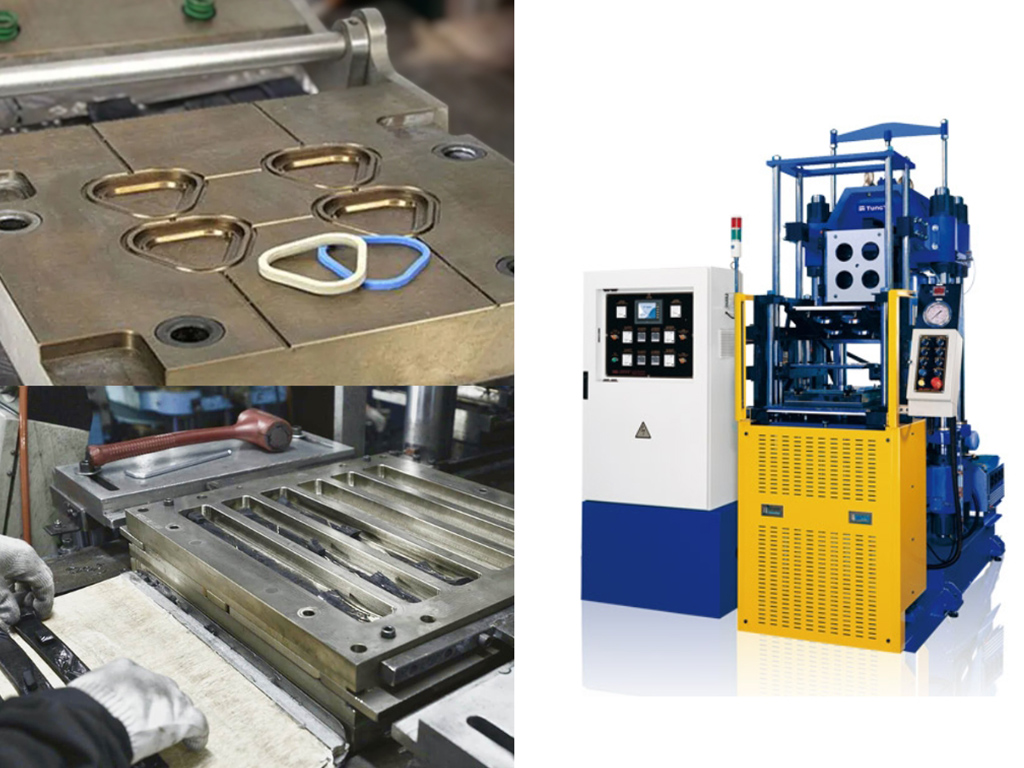
Rubber molds in industrial manufacturing
This material is used to make rubber casting molds for products with complex shapes or when flexible demolding is required. Silicone rubber and polyurethane are used to mold plastics, waxes, composites, and technical parts. Rubber also serves as a cushion layer in compression molds to apply uniform pressure over product surfaces. This application is common in electrical components, plastic goods, and precision-manufactured products at scale.
Producing thermal and cold-insulation materials
Rubber is used to produce insulation tubes and sheets for refrigeration, air-conditioning, and industrial heat-transfer systems. With a closed-cell structure and heat resistance, rubber limits heat loss, prevents condensation, and protects pipe surfaces from corrosion. It is lightweight, easy to install, and durable in humid environments-ideal for food plants, cold storage, and industrial HVAC.
Rubber is an essential engineering material across many industrial fields. Thanks to its adaptability, durability, and environmental resilience, rubber improves operational efficiency, extends equipment life, and reduces technical risk. Understanding its uses and choosing the right rubber type will deliver long-term benefits for production systems and industrial infrastructure.
See also: A detailed guide to cast rubber