


Rubber injection molding offers the ability to produce highly precise products through a stable and consistent process. This technology has become the optimal choice for many businesses involved in manufacturing rubber components, devices, and accessories. In this article, Thai Duong Plastics provides a comprehensive overview of the working principles, outstanding advantages, and common applications of rubber injection molding technology.
What is Rubber Injection Molding?
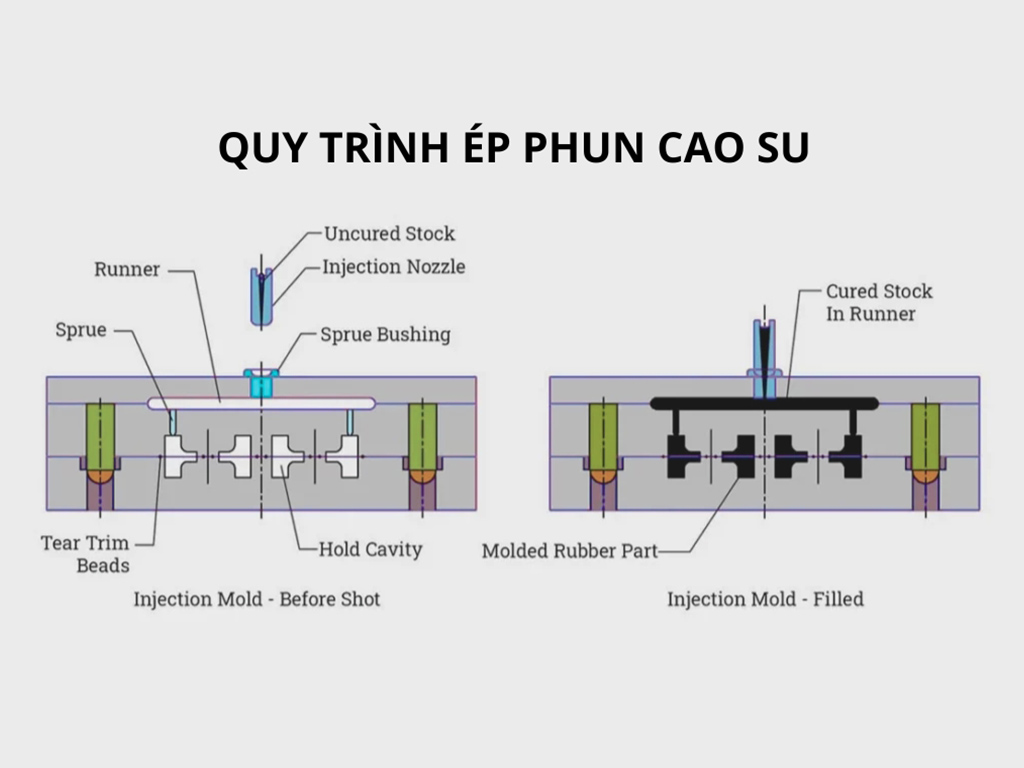
Rubber injection molding is a manufacturing method that uses an injection molding machine to feed rubber material into a mold through a screw and hydraulic pump system. Once inside the mold, the material is heated to the appropriate vulcanization temperature, then cooled to form a finished product. This technique enables the creation of complex shapes with high precision and consistent reproduction.

Additionally, rubber injection molding offers an effective solution for quality control in large-scale production. Unlike traditional rubber processing methods, this technique enables a closed-loop process-from material feeding to final product formation. Each item is strictly monitored for size, durability, and consistency.
Read more: Industrial rubber molding
How Does a Rubber Injection Molding Machine Work?
The rubber injection molding process begins when pre-mixed rubber is fed into the hopper. The machine’s screw transports the material into a heating chamber, where it is compressed and heated to a suitable plasticized state. The material is then pushed through the nozzle into the mold via a runner and sprue system.
The mold is tightly sealed and consistently heated to ensure effective vulcanization. Once the cavity is fully filled with rubber, the material’s molecular structure is set, producing a product with excellent elasticity and durability. Finally, the mold automatically opens, and the rubber product is ejected easily-ideal for high-precision mass production.
Advantages of Rubber Injection Molding Technology
Rubber injection molding offers several outstanding benefits in production, including:
High Production Efficiency
A continuous and synchronized operation system helps reduce cycle time. Multiple mold stations can work simultaneously, optimizing time and increasing output.
Full Automation
Easily integrated into modern production lines thanks to multi-directional mold accessibility. Automation reduces labor dependence and minimizes production errors.
Optimized Operation and Maintenance
Machine designs allow for flexible height adjustment, facilitating operation and maintenance. Safety features like light curtains ensure safe and accurate handling.
Accurate Quality Control
Electronic controllers and hydraulic injection systems ensure precise material injection, maintaining consistent product quality across production batches.
Energy Efficiency
Low-friction designs and smart electro-hydraulic control systems help save electricity and reduce cooling water consumption, thereby improving operational efficiency.
Differences Between Rubber and Plastic Injection Molding
Though both utilize injection molding techniques, these two processes differ in several key aspects:
| Comparison Table: Rubber vs. Plastic Injection Molding | |||
| No. | Criteria | Rubber Injection | Plastic Injection |
| 1 | Material | Natural rubber, NBR, EPDM, silicone-flexible and elastic materials | PP, PVC, PS-thermoplastics with high hardness and mechanical strength |
| 2 | Processing Parameters | Low pressure, longer vulcanization time | High pressure, shorter cycles |
| 3 | Mold Design | Flexible molds suited for soft, stretchable materials | Plastic molds are rigid, high-pressure resistant, and highly precise |
| 4 | Cost | Higher mold cost and longer production time-suitable for specialized technical products | Lower cost-suitable for high-speed mass production |
Learn more: Overview of Plastic Injection Molding
Practical Applications of Rubber Injection Molding
Rubber injection molding technology is widely used across various industries due to its flexibility and consistent product quality:
- Insulating parts, rubber buttons, protective covers in electronics and telecommunications
- Thermal insulation components, pressure valves, anti-slip bases in the medical field
- Manufacturing wheels, tires, rubber boots, mining products in heavy industries
- Producing rubber gaskets, dampers, seals, air ducts for the automotive industry
- Manufacturing consumer and sports goods such as silicone accessories, shoe soles, and gym equipment

Rubber injection molding technology continues to play a vital role in industrial manufacturing thanks to its high precision, stability, and economic efficiency. Investing in the right equipment not only streamlines the production process but also improves product quality and productivity.
Thai Duong Plastics proudly offers advanced rubber injection molding machines and expert technical services to meet the diverse needs of domestic and international enterprises. Contact us now for tailored solutions.
See also: Custom Rubber Processing Services