

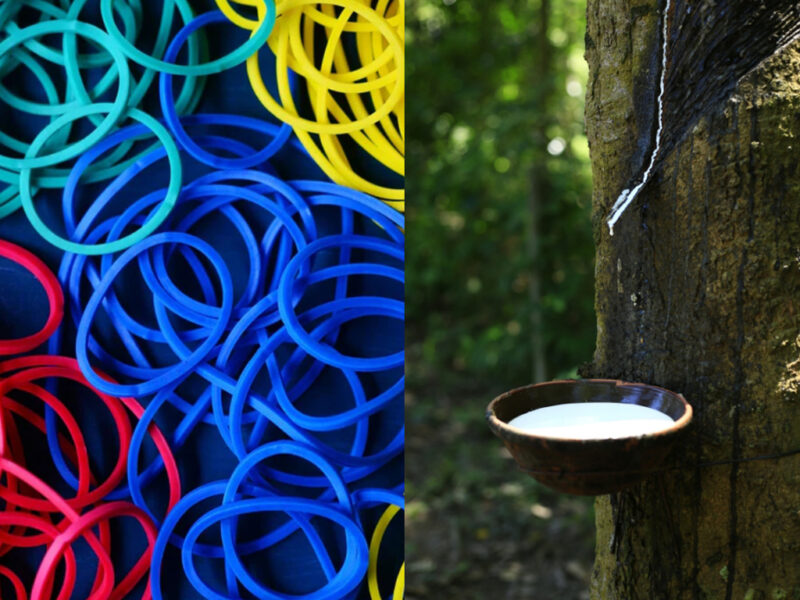
Why is rubber such a critical material in both everyday life and industrial production? In the article below, Thai Duong Plastics explains the origin, characteristics, classifications, and most common applications of rubber today.
General Overview of Rubber
Rubber is an elastic polymer that can deform under force and quickly return to its original shape once the force is removed. This outstanding elasticity has made rubber indispensable in many fields, including daily life, industry, transportation, healthcare, construction, and electronics.
Historical Development
Indigenous peoples in South America had used rubber for centuries, but only in the 19th century – after Henry Wickham took rubber seeds from Brazil to Asia via Britain – did the global rubber industry truly flourish.
The major turning point came with Charles Goodyear’s discovery of vulcanization in 1839. Vulcanization improved rubber’s durability, heat resistance, and elasticity, transforming it from a perishable material into a robust industrial raw material suitable for mass production.
Key Properties
Rubber offers a range of notable physical and chemical properties:
- High elasticity, allowing stretching or compression without permanent deformation.
- Excellent electrical and thermal insulation.
- Waterproof and insoluble in common solvents.
- Good abrasion and impact resistance.
- Can be vulcanized to enhance strength and chemical resistance.
Rubber Types and Production Processes
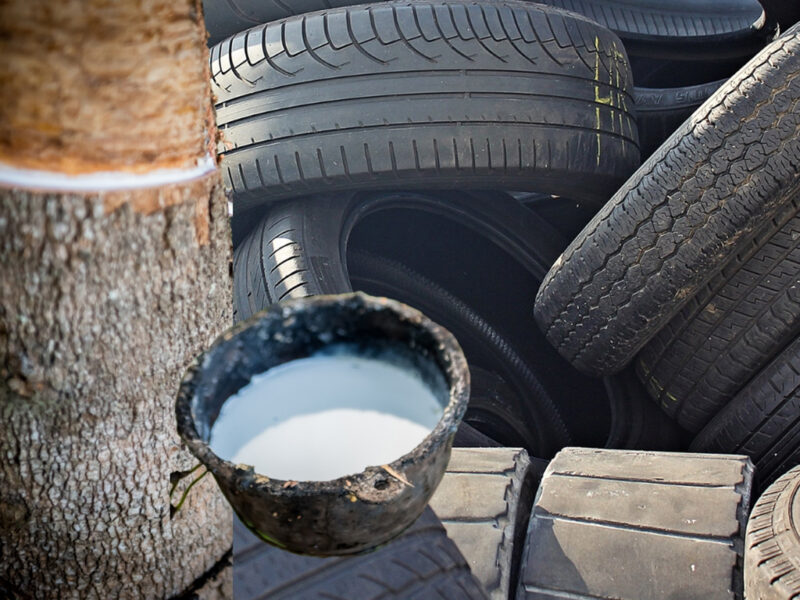
Based on origin, rubber is divided into two main groups: natural rubber and synthetic rubber. Natural rubber is extracted from the latex of Hevea brasiliensis, while synthetic rubber is produced by polymerizing petrochemical compounds.
Natural Rubber
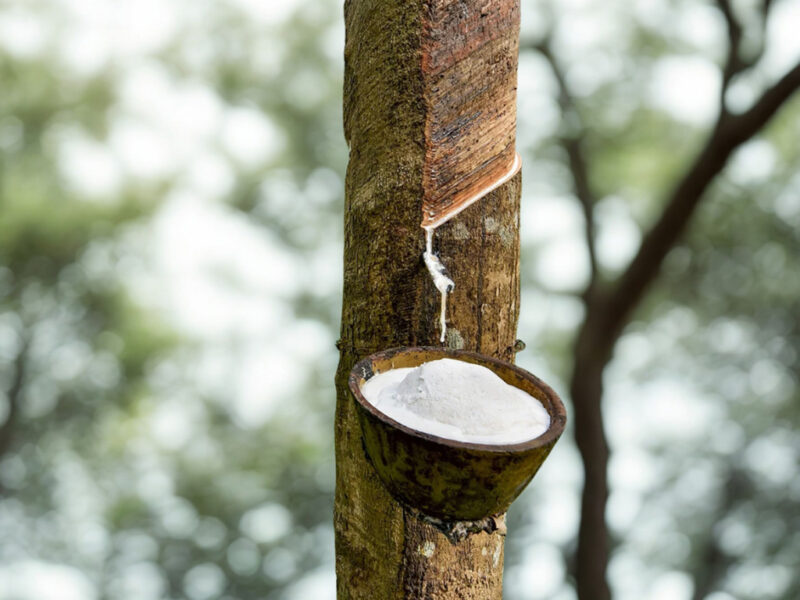
Natural rubber is harvested by tapping latex from rubber trees, filtering impurities, coagulating with acid, rolling into sheets, and drying. The final product is typically formed into rubber sheets or crude rubber blocks for further processing.
This material excels in elasticity, mechanical strength, and biodegradability. However, it is sensitive to weather conditions and incurs higher production costs because it relies on plant-based resources.
Synthetic Rubber
Synthetic rubber can be produced year-round at lower cost. It is created from chemical compounds such as butadiene, isoprene, and styrene through polymerization. Common synthetic rubbers include:
- Styrene-butadiene rubber (SBR): Widely used in tire manufacturing.
- Butyl rubber (IIR): Gas-impermeable; used in inner tubes and insulation materials.
- Nitrile rubber (NBR): Oil-resistant; applied in mechanical and automotive parts.
- EPDM: Heat- and weather-resistant; used for gaskets and seals.
- Chloroprene rubber (CR – Neoprene): Oil- and weather-resistant; used in heavy industry.
Synthetic rubber production involves three main stages: monomer polymerization in reactors, purification, and shaping via industrial rubber molding, calendering, or extrusion. Depending on the product, rubber may be blended with additives and vulcanized with sulfur to enhance technical properties.
Practical Applications of Rubber
Rubber’s elasticity, durability, and insulating properties make it essential in numerous fields:
- Transportation: Tires, inner tubes, shock absorbers, pads…
- Mechanical, electrical & electronics: Seals, belts, pressure hoses, insulating materials, anti-vibration mounts…
- Construction: Gaskets, waterproofing membranes, acoustic and thermal insulation…
- Healthcare: Gloves, medical tubing, stoppers…
- Consumer goods: Footwear, sports gear, stationery, household items…
Use in Injection Molding
In plastic and rubber injection molding, rubber is used to create high-precision, elastic components such as plugs, seals, and device housings. Rubber injection molding requires strict control of temperature, pressure, and time to ensure product quality, extend mold life, and optimize costs.

The Role of the Rubber Industry in Vietnam
Vietnam is among the world’s top natural-rubber exporters. With more than 800,000 ha of plantations, the 2023 output was estimated at roughly 1.2 million tons. Vietnamese rubber meets domestic industrial demand and is exported to major markets such as China, India, South Korea, and the United States.
The industry is gradually shifting toward sustainability, expanding markets, improving product quality, and enhancing the value chain to boost international competitiveness.
We hope this article has given you an overview of rubber and its importance in Vietnam’s economy. For more information or expert advice on materials, please contact Thai Duong Plastics for prompt, thorough support.
Reference: Technical Rubber: Characteristics & the Most Common Types