

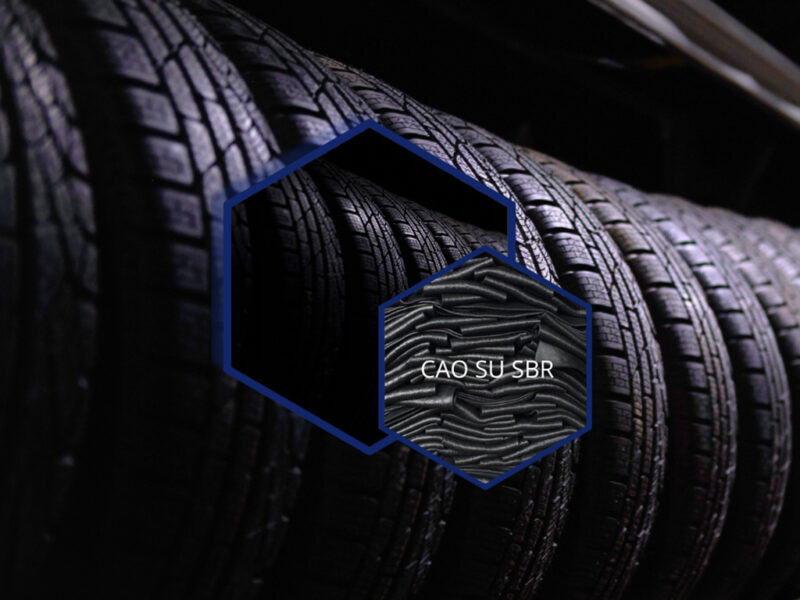
SBR (Styrene-Butadiene Rubber) is a synthetic rubber produced by the copolymerization of two main monomers: styrene and butadiene. It is one of the most widely used materials among synthetic rubbers today-especially in tire manufacturing and engineering rubber products-thanks to its good mechanical strength, high abrasion resistance, and stability across diverse environmental conditions.
Composition and structure of SBR
SBR is a copolymer, meaning a polymer formed from two different monomers. Styrene increases hardness and surface formability, while butadiene provides elasticity and impact resistance. The typical styrene-to-butadiene ratio in SBR is about 23.5% styrene and 76.5% butadiene. This ratio can be adjusted depending on the technical requirements of each application.
The most common production route for SBR is emulsion polymerization. In this method, styrene and butadiene are dispersed in water along with emulsifiers and catalysts to form the polymer. When conducted at a low temperature of around 5 °C, it is called cold emulsion polymerization and yields a product with more linear, flexible chains. Conversely, polymerization at higher temperatures can create branched chains that reduce the material’s elasticity.
In addition to the emulsion method, SBR is also produced by solution polymerization. This method yields a polymer with a more uniform structure, improved mechanical properties, and enhanced adhesion, and is commonly used in high-performance applications.

Common types of SBR
SBR is divided into two main groups based on the production method:
Emulsion SBR (E-SBR)
Produced by emulsion polymerization; common grades include non–oil-extended SBR 1500, SBR 1502… or oil-extended SBR 1712 to improve processability. E-SBR is cost-effective and suitable for general-purpose applications.
Solution SBR (S-SBR)
Produced by solution polymerization, providing a more uniform polymer structure with improved abrasion resistance and mechanical properties. It is often used in high-performance tires or applications requiring tightly specified properties.
Reference: What is rubber and common classifications
Properties of SBR rubber (water and ozone resistance)
SBR has many notable characteristics that make it a popular material choice in industrial manufacturing:
- High mechanical strength: SBR offers good tensile strength, abrasion resistance, and impact resistance, especially when reinforced with fillers (carbon black, silica, etc.).
- Good elasticity: While lower than natural rubber, it is sufficient for applications requiring elasticity and toughness.
- Chemical resistance: SBR resists organic acids, mild inorganic acids, alkalis, water, alcohols… but has poor resistance to petroleum oils, aromatic solvents, and chlorinated hydrocarbons.
- Stable heat resistance: Performs effectively from −40 to 100 °C, depending on the compound formulation and vulcanization conditions.
- Good aging resistance: Compared with natural rubber, SBR is less affected by weathering, light, and ozone when antioxidants/antiozonants are incorporated.
- Flexible blendability: SBR blends readily with natural rubber, butadiene rubber, and other polymers to enhance performance.
Practical applications of SBR
Below are some common applications of SBR across industries:
- Tire manufacturing: The largest end-use for SBR. SBR is used in treads to increase traction and extend tire life.
- Engineering rubber products: Used in load-bearing technical parts, gaskets, rubber pads, hoses, conveyor belts, rubber mats, etc.
- Consumer goods: Applicable to footwear, floor mats, toys, and other items requiring durability and elasticity.
- Electrical insulation materials: Thanks to its relatively good insulating properties and abrasion resistance, SBR can be used for jacketing and insulation in certain cables and electrical accessories.

Applications in industrial rubber processing
SBR is widely used in rubber processing methods such as compression molding, transfer molding, and injection molding. Owing to its stable behavior during vulcanization, uniform mold fill, and easily controlled viscosity, SBR is well-suited for producing engineering rubber parts in a wide range of shapes.
In compression and transfer molding, SBR delivers consistent mechanical strength, uniform finished surfaces, and reasonable production cycle times. For injection molding-though less common than materials better suited to this process-SBR can still be used if the compound formulation is properly adjusted.
Drawbacks and usage limits to note
Despite its many advantages, SBR also has some limitations to keep in mind:
- Poor resistance to oils and organic solvents, making it unsuitable for oil-rich environments.
- Lower tensile strength and elasticity than natural rubber.
- Can age rapidly if appropriate antioxidants and anti-aging additives are not used.
SBR is one of today’s most important synthetic rubbers, capable of meeting the demands of many industries. However, to optimize performance, it is essential to consider working conditions, environment, and product specifications to choose the most suitable SBR grade. Please contact Thai Duong Plastics for advice on materials and modern methods of industrial rubber molding.